The 3-Line Resume Summary Formula That Actually Works
Ditch generic resume summaries in 2026. Learn the 3-line formula that gets interviews, with examples, checklists, and pro tips to apply fast.
By Yuvraj Bajwa, Founder, Resumae
July 3, 2026 · Updated August 7, 2026 · 3 min read
Resumae articles are written to help job seekers make better application decisions and are reviewed against our editorial policy.
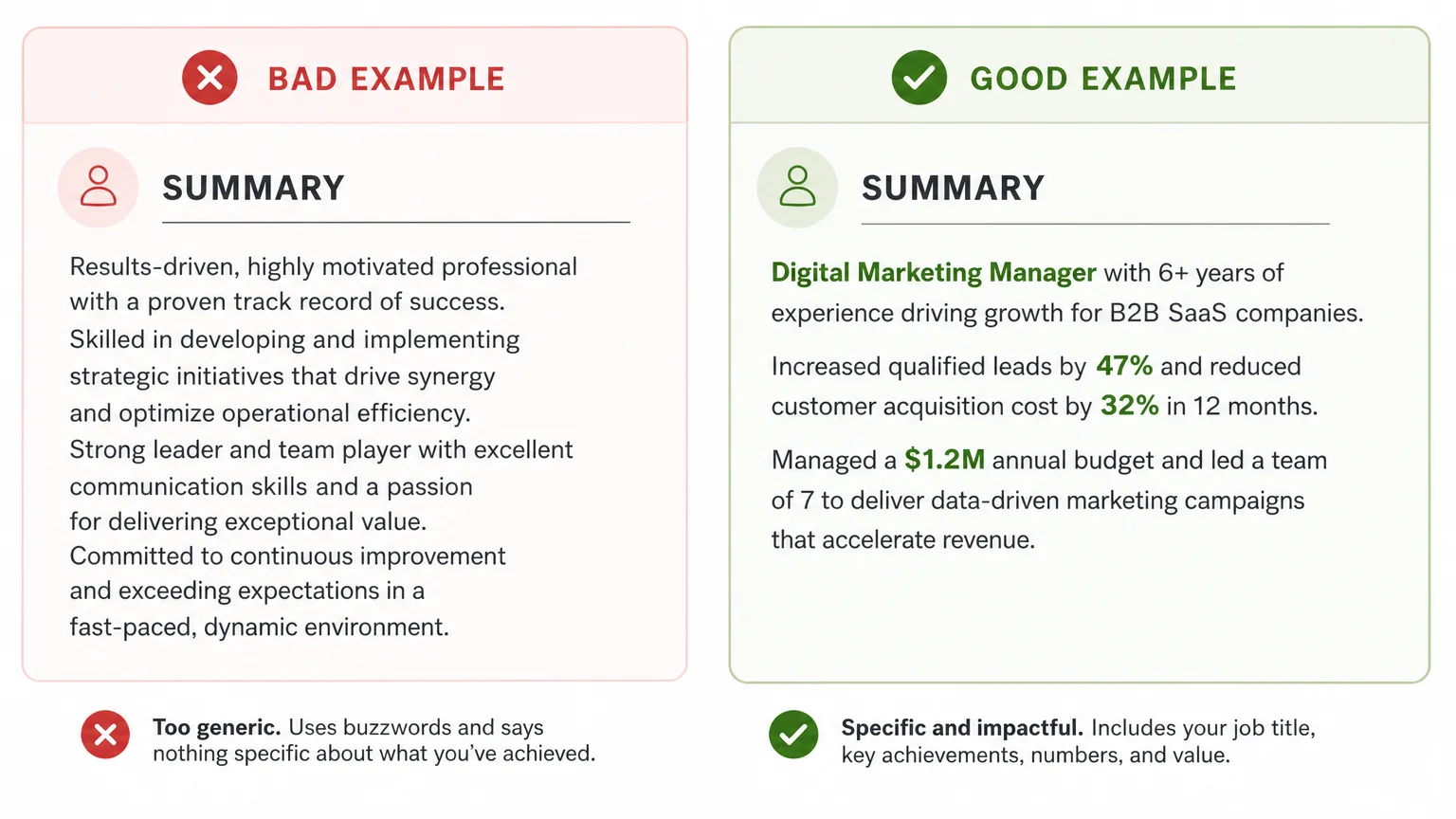
Most resume summaries burn a paragraph saying nothing at all. You’ve seen it. “Results-oriented professional with proven track record of success.” That tells me nothing. Could be a barista talking. Could be a software engineer.
Your summary sits near the top of the page, right below your name. If it’s generic, the hiring manager has no reason to read on.
This post gives you a 3-line formula, plus examples you can adapt.
The Most Common Mistake (And How to Avoid It)
People write the summary like a mission statement. That’s the biggest mistake.
“I am a dedicated professional seeking to leverage my skills in a collaborative environment.”
That could sit on a grocery clerk’s resume or a CFO’s. It means nothing.
Fix it by being specific. Every word should separate you from the next candidate. Ask yourself: “If I changed my name, would this still sound like me?” If yes, rewrite it.
Example of a real, specific summary:
“Registered nurse specializing in pediatric emergency care. Managed 15+ critical cases per shift and reduced ER wait times by 22% through a new triage protocol. Seeking a charge nurse role at a Level 1 trauma center.”
That one tells you her role, gives you a result, and names the job she wants.
Should You Even Have a Summary?
If you have 3+ years of experience, use one. If you’re a student or recent grad, use an objective statement instead.
For career changers: A summary is critical. It bridges your past work and your new direction.
Example:
“Project manager transitioning into product management. Led cross-functional teams to deliver $5M in software projects on time and under budget. Certified Scrum Master, learning UX research.”
The shift becomes obvious.
For senior leaders: Keep it to 2 lines. Your record speaks for itself. Name your domain and one top result.
Pro Tip: Write the Summary Last
Your brain will push you to start with the summary. Don’t. Write your bullet points first, your skills, your experience. Then look at what themes keep showing up and summarize those.
What you get will reflect your resume, not some generic statement of intent.
Quick Checklist for Your Summary
| Element | What to Check |
|---|---|
| Line 1 | Does it include your job title and a specific skill or industry? |
| Line 2 | Is there a number, percentage, or measurable result? |
| Line 3 | Is it optional? Does it clarify your target role? |
| Length | 2-3 lines maximum. Under 60 words. |
| Specificity | Could another candidate copy this? If yes, rewrite. |
Back It Up With Data
When you name a specific role, back it with a measurable achievement, and point it in a target direction, the recruiter gets more to evaluate. That also makes the summary far easier to tailor to any job description.
For more ways to strengthen your resume, check out AI resume tailoring guide, ATS resume optimization guide, and resume keyword matching guide.
Key takeaways:
- Use the 3-line formula: identity, achievement, goal.
- Be specific. Generic sentences hurt you.
- Write it last so it reflects your actual experience.
Recruiters often read the summary first. Spend 10 minutes rewriting it and the rest of the resume gains a clearer starting point.
Build your resume summary on Resumae.xyz in under 5 minutes. It’s free.

About the author
Yuvraj Bajwa
Founder, Resumae
Yuvraj Bajwa is the founder of Resumae, an AI job-search workspace built as part of Coffee Drop Studio. He writes and reviews the resume, cover letter, interview, and application-tracking guidance on this site, drawing on the day-to-day work of building the tailoring, fit analysis, and ATS tools the articles describe.
- Founder
- Product lead
Related reading
How to Explain a Career Gap on Your Resume in 2026
Get recruiter-backed scripts to explain employment gaps on your resume, cover letter, and interviews in 2026 without sounding defensive or vague.
The Complete 2026 Guide to Remote Resumes
Tailor your resume for remote roles in 2026 with remote keywords, ATS tips, AI tools, and a final checklist to land work-from-anywhere interviews.
LinkedIn Optimization Guide 2026: Get Recruited Faster
Turn your LinkedIn into a 24/7 job magnet in 2026. Follow data-backed steps for headlines, summaries, AI optimization, and a printable checklist.
Next step
Ready to build a resume that gets noticed?
Paste a job description and let AI tailor your resume - free plan, no credit card required.