Sent 50 Resumes & Got Zero Callbacks: What Am I Doing Wrong?
Zero callbacks after 50 applications is fixable. See the real reasons your resume is being ignored and fix your next 50 applications.
WorkHunt articles are written to help job seekers make better application decisions and are reviewed against our editorial policy.

You’ve sent out 50 resumes. Tailored them, sort of. Hit “submit” more times than you can count.
Your inbox? Radio silence.
That isn’t because of you. The system itself is broken. But here’s the good news: that system is predictable, and once you see how it really operates, you can fix it.
Full disclosure: this guide comes from the WorkHunt team. We build WorkHunt, a tool that tailors your resume to each job posting, so this article is shaped by what we’ve learned making that product. We’ll also flag which numbers are rock-solid and which are shakier than they look.
Let’s break down why you’re getting ghosted and what to do about it.
The Math You Should Expect
First, the numbers game. If you’re getting zero callbacks, you need to know what “normal” looks like.
CareerPlug analyzed over 10 million job applications in 2024 and found something sobering: only about 3% of applicants reached the interview stage (according to CareerPlug’s 2024 data, as summarized in this analysis). That’s not a typo. For every 100 applicants, roughly 3 get an interview.
So let’s do the math on your situation. Fifty applications at a 3% interview rate means you’d expect about 1.5 interviews. Statistically, you could easily get zero through random chance alone.
But here’s the thing: that 3% average includes everyone. Including people who uploaded the wrong file, people who clearly didn’t read the job description, and people who applied to roles they were wildly unqualified for.
Your goal isn’t to hit the average. It’s to beat it.
The Myth You Need to Stop Believing
Before we fix anything, let’s kill a myth.
You’ve probably heard it: “75% of resumes are auto-rejected by ATS before a human ever sees them”. It’s quoted everywhere, feels true, and makes a great headline.
But it’s not backed by evidence. Researchers have tried to track this statistic to its origin and come up empty. Repeated often enough, it just became accepted as truth.
ATS (Applicant Tracking Systems) actually organize, rank, and filter. That’s the whole job. They don’t reject you; real recruiters make those calls.
Across interviews with 25 recruiters, most said ATS helps them sort candidates by relevance. It flags keywords and parses experience. It may rank you against other applicants. But there’s no tiny robot gavel issuing unilateral rejections.
So stop blaming the ATS. Fix what you can control.
Culprit #1: The One-Size-Fits-All Resume
Are you sending the same resume everywhere? Then that’s the problem.
Recruiters spot generic submissions in seconds. It reads like any job would do, not this one. Hiring managers see that and assume you’d take anything, which makes them think you’ll bolt when something better appears.
The fix: Treat each application as a mini-project. Not a full rewrite 50 times over; keep the core content, change the framing.
For each role:
- Read the job description twice.
- Pull out the 5-7 most important skills or experiences they list.
- Mirror those exact skills in your summary and top bullets.
An extra 20 minutes per application? Yes. Worth it? Absolutely. Tailored resumes get replies; generic ones get filed away.
Culprit #2: The Keyword Mismatch
This one is subtle, and it’s where ATS genuinely can hurt you.
ATS systems match keywords literally. They lack the sense to recognize that “managed a team” means the same as “supervised staff”.
If the job description says “project management” but your resume says “oversaw initiatives,” the ATS might not connect those dots. You have the right experience. But the system can’t tell.
The fix: Stop paraphrasing the job description. Use their words.
Does this feel like cheating? Maybe. But here’s the reality: you’re not lying. You’re just making it easy for the system (and the recruiter) to see that you fit the role.
Your action step: pull 3 job descriptions for roles you actually want. Circle the keywords they use for skills you have. Now rewrite those skills on your resume using the exact same phrasing.
Culprit #3: Vague Accomplishments
“Responsible for social media.”
“Managed a team.”
“Improved sales.”
Sound familiar? These are what we call “duty statements.” They describe what you were supposed to do. Hiring managers don’t care about that.
They care about what you actually achieved.
Think about it from the recruiter’s perspective. They have 200 resumes to get through. They spend about 6 seconds on each one. A vague statement like “responsible for social media” gives them nothing to grab onto. But “grew Instagram following from 2K to 15K in 6 months” gives them a reason to keep reading.
Here’s what this looks like in practice:
| Weak (Duty) | Strong (Achievement) |
|---|---|
| “Responsible for social media” | “Grew Instagram following from 2K to 15K in 6 months” |
| “Managed a team” | “Led a team of 5, reducing project delivery time by 30%” |
| “Handled customer complaints” | “Resolved 50+ complaints weekly with 95% satisfaction rate” |
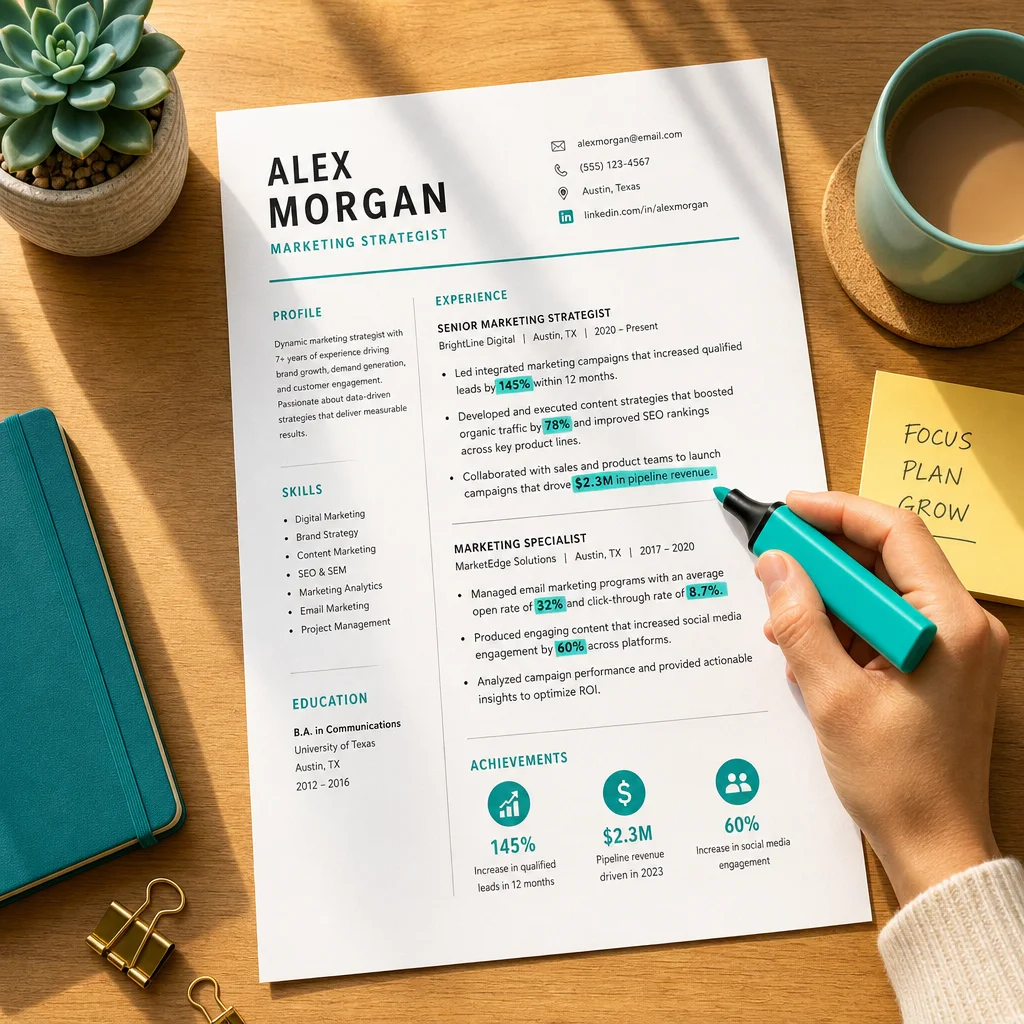
The fix: Add numbers. Every bullet point should have at least one metric.
Don’t know the exact number? Estimate conservatively. “Reduced costs by approximately 15%” is better than “reduced costs significantly.”
Culprit #4: Applying to Wrong-Fit Roles
This one hurts because it’s easy to do. You need a job. You’ve sent out 50 applications. So you start applying to anything that looks even remotely relevant.
Here’s the problem: applying to everything means fitting nothing.
When you apply to a role, ask yourself one question: “Can I do this job on day one?” If the answer is “maybe” or “I could learn”, that’s a weak application.
What about stretch roles, or jobs where you learn as you go? Those exist. They’re the exception, though, not the rule. When you’re getting zero callbacks, you need a strategic approach. Maximize your hit rate.
The fix: Aim for quality over quantity. Apply to 5 jobs daily that you’re genuinely qualified for, not 50 that you’re clearly not a fit for.
How do you evaluate fit? Read the first 5 requirements in the job description. Can your resume directly address all 5? If not, move on. That role is a stretch.
Culprit #5: Formatting That Breaks Parsing
You’ve got a perfect resume: great keywords, solid numbers, tailored to the role. Then the ATS garbles everything.
This happens more than people realize. One analysis of 1,000 rejected resumes found that 43% were rejected due to formatting, parsing, or filter failures were lost to format issues, not qualification gaps. (It’s worth noting this is a single blogger’s analysis, not peer-reviewed research, so treat that percentage as directional. The underlying pattern, however, is real.)
So what breaks parsing?
- Tables and text boxes (the ATS can’t always read them)
- Odd fonts that confuse the system
- Headers and footers with critical info (some systems skip them)
- PDFs that were never properly converted
- Columns. Please. Don’t use columns.
The fix is simple: choose a straightforward, single-column resume format with standard fonts, no tables, no graphics. Put your name and contact info at the top, and arrange sections in a logical order.
It’s not an exciting design. But it works. By the time a human sees it, they’ll care about your content, not the layout.
Your Action Checklist for the Next 50 Applications
Before you submit your next application, run through this checklist. Every. Single. Time.
- Read the job description. Twice.
- Identify the 5-7 key skills they’re asking for.
- Mirror those exact keywords in your resume summary and top bullet points.
- Quantify at least 3 bullets with specific metrics (“grew by 40%”, “reduced costs by $10K”).
- Lead each bullet with a strong action verb (“built”, “launched”, “grew”, “led”).
- Check that you can directly address the first 5 requirements. If not, skip this role.
- Use a clean, single-column format. No tables, no text boxes, no graphics.
- Save as PDF, with a filename like “Name-Role.pdf”, not “resume_FINAL_v3.pdf”.
- Before submitting, re-read the job description one more time. Ask: “Did I mirror their language?”
That’s it. 15 minutes per application. It’s not flashy. But it’s the difference between getting ignored and getting a callback.
The Real Game: Numbers + Quality
Here’s the reframe you need to hear.
Zero callbacks after 50 applications doesn’t mean you’re unqualified. It doesn’t mean you’re unhireable. It means your application strategy isn’t aligned with how hiring actually works.
The average applicant-to-interview rate is around 3%. But that average includes everyone, the lazy, the sloppy, and the unprepared.
You’re not playing the average game. You’re playing the beats the average game.
That means:
- Fewer, better applications (quality over quantity)
- Tailored, keyword-matched resumes
- Achievements with numbers, not duties without
- A format that doesn’t break the system
It’s more work per application. But it’s work that actually pays off.

Stop Gambling. Start Building.
Sending 50 identical resumes into the void isn’t a strategy. It’s gambling.
And you’re tired of losing, right?
The good news? You don’t need to gamble. You need a system. A repeatable process that maximizes your chances with every single application.
Start with the checklist above. Run it on your next 5 applications instead of your next 50. See what changes.
And if you’d rather not do the matching by hand, WorkHunt reads the posting, shows which of its requirements and keywords your resume already covers, and suggests edits you keep or revert one by one. Nothing changes without your approval, and it’s free to try.
Key takeaways:
- 3% is the average interview rate. Zero callbacks from 50 applications is normal, not a personal failure.
- The 75% ATS rejection myth is not backed by evidence. ATS rank and filter; they don’t make hiring decisions.
- Tailor every application. Match keywords, quantify achievements, and apply to roles you’re actually qualified for.
It’s a numbers game. But it’s a numbers game you can win.
FAQ: Why Am I Getting Zero Callbacks?
Is a 3% callback rate normal?
Yes. CareerPlug’s analysis of over 10 million applications in 2024 found that only about 3% of applicants reached the interview stage. After 50 applications, getting zero callbacks is statistically unsurprising, but it also means you have room to beat the average.
Does ATS really reject resumes?
Not the way the myth says. The “75% of resumes are auto-rejected” statistic is not backed by evidence. ATS systems organize, rank, and filter candidates, but recruiters still make the final call. What ATS does do is match keywords literally, so using the same language as the job description matters.
How long should I spend tailoring a resume?
Around 15 to 20 minutes per application. Read the job description twice, identify the 5-7 key skills, mirror their keywords in your summary and top bullets, and quantify at least 3 accomplishments. That routine is what separates a generic submission from one that gets read.
What is the most common reason resumes get zero callbacks?
”}
The biggest pattern is a generic, untailored resume. Vague duty statements, missing metrics, and keyword mismatches all make it easy for a recruiter to archive your application. Fix those three first, then move on to targeting roles you’re genuinely qualified for.

Yuvraj Bajwa
Editorial AuthorFounder, WorkHunt
Yuvraj Bajwa is the founder of WorkHunt, an AI job-search workspace built as part of Coffee Drop Studio. He writes and reviews the resume, cover letter, interview, and application-tracking guidance on this site, drawing on the day-to-day work of building the tailoring, fit analysis, and ATS tools the articles describe.
- Founder
- Product lead