10 Things to Remove From Your Resume Right Now
Stop sabotaging your job search in 2026. Here are 10 outdated resume elements that trigger rejection and exactly what to replace them with today.
By Yuvraj Bajwa, Founder, WorkHunt
July 12, 2026 · Updated August 7, 2026 · 6 min read
2026 Hiring GuideWorkHunt articles are written to help job seekers make better application decisions and are reviewed against our editorial policy.

Recruiters spend only a few seconds on a resume at first glance. One outdated element can sink that initial review, and certain formatting choices can scramble the file into gibberish for an ATS.
Lots of job seekers still bring old advice into the application process. The issue is usually the resume itself, not their qualifications.
Advice on resumes has shifted. What was standard in 2019 may actually hurt you in 2025, so it’s worth clearing out the dated parts.
1. The Objective Statement
Start here.
“Seeking a challenging position that utilizes my skills…” says nothing about what you can do.
Recruiters don’t care what you want from a job. They care what you can do for them.
Replace it with: A 2-3 sentence professional summary that highlights your biggest wins and the specific value you bring. Think of it as your headline.
Bad: “Seeking a challenging position in project management where I can utilize my organizational skills.”
Good: “Project manager with 8 years of experience delivering $2M+ projects on time and 15% under budget. Certified PMP with a track record of turning around struggling initiatives.”
The first statement describes what you want. The second gives evidence of what you can deliver.
Source: Work It Daily, Fast Company, IQ Partners
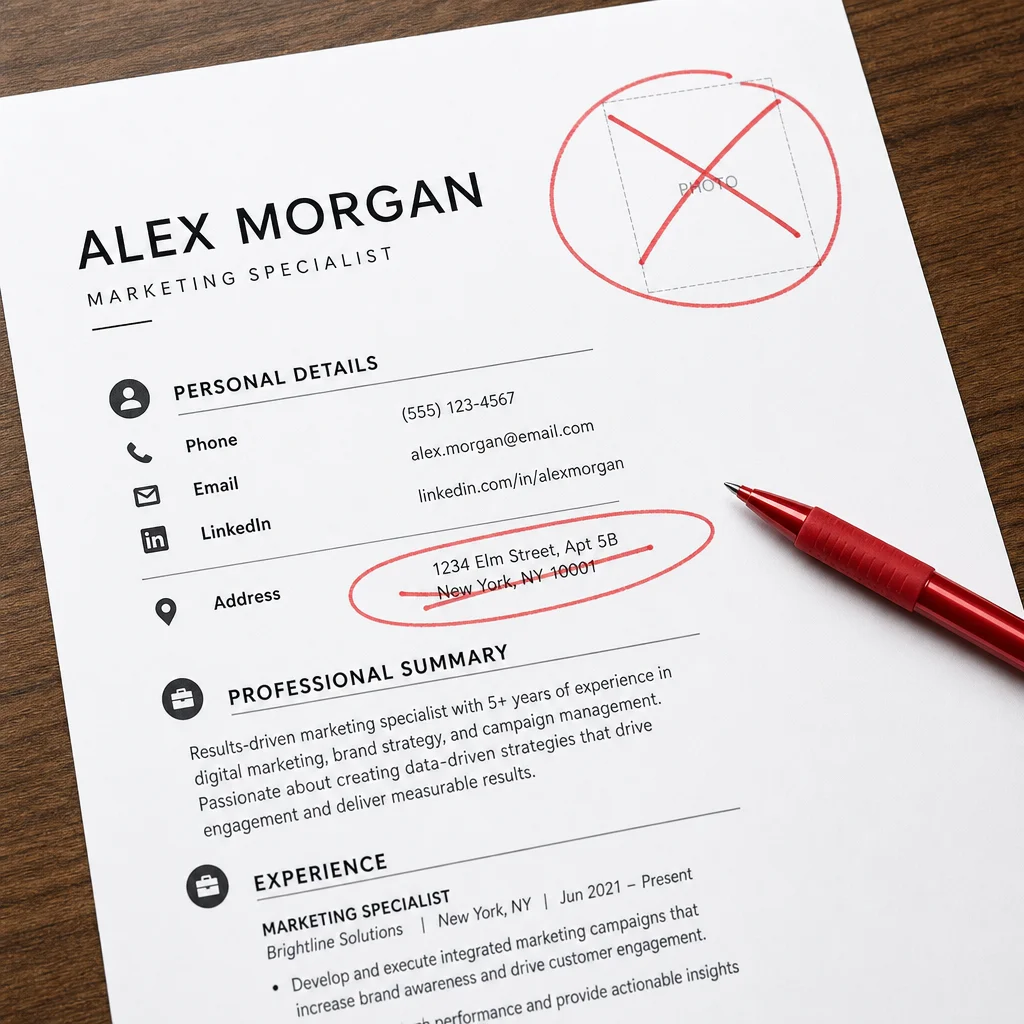
2. Personal Information (Photo, Address, Age, Marital Status, Religion)
Even now, these details show up on resumes, and they almost never help.
Recruiters are only human. Unconscious bias is real, and a photo, age, or marital status can shape their reaction before they’ve read a single bullet point. Discrimination is illegal, but proving it is another matter entirely.
For ATS systems? A photo contributes nothing. An address just signals you might not be local. Your age? One more reason to filter you out.
Keep it simple: name, phone number, professional email, LinkedIn profile, and optionally your city/state.
That’s all you need.
Source: Work It Daily, ClearanceJobs, ECP Careers
3. Work Experience Older Than 10-15 Years
That internship from 2006 might still make you proud, but it probably isn’t helping your application anymore.
Once you cross the 10-15 year mark, each additional year of old experience just pulls attention away from what you’ve done recently. Jobs from 15+ years ago tend to feature outdated technology, titles, and skills. Recruiters want to see your recent work.
Worried about looking young? Cutting old jobs won’t hurt you. What matters is recent, relevant impact.
Replace it with: A “Prior Experience” section if you need one, or drop it entirely. Focus on the last 10-15 years with strong, quantified achievements. For more guidance, consider structuring your career history for maximum impact.
Source: Talentplace, Investopedia, Hireize
4. Hobbies and Interests (Unless They Prove Something)
“I enjoy hiking, reading, and spending time with family.”
That line eats up space without telling the recruiter much. Unless the hobby is directly relevant to the job, cut it.
The exception: When a hobby demonstrates a transferable skill. “Founded a local running club that grew to 200 members” shows leadership and community building. “Built a custom PC from scratch” shows technical aptitude.
Otherwise, use that space for achievements that prove you can do the job.
5. “References Available Upon Request”
This one’s about as easy to remove as it gets.
Recruiters already expect references on request, so that line is dead weight. It says nothing and just eats space.
Use the spot for something real instead: nothing at all, or one more bullet point that shows a concrete win. Curious what else you can cut? Check out the most common resume filler mistakes.

6. Generic AI-Generated Content
Recruiters are getting sharper at spotting AI-written resumes. Generic wording can raise concerns in 2025, especially when phrases like “Results-oriented professional with a proven track record” sound copied. Those lines lack specifics and never show what you actually did.
Write it in your own voice. Include your numbers. Personalize everything, and suddenly the resume reads like yours rather than another template.
Source: ResumeGenius, Nate’s Newsletter
7. Hard-to-Read Formatting (Tables, Columns, Graphics, Fancy Fonts)
That two-column template might look sharp, but your ATS software may not read it well at all. Systems parse text linearly. Columns and tables can jumble your experience or skip entire sections entirely. Graphics and icons often disappear from the system’s view.
Stick with a clean single-column layout and standard fonts like Arial, Calibri, or Times New Roman. No tables, no columns, no graphics. Want a deeper dive into ATS-friendly design? Research resume formatting for 2025.
Source: Monster, HireFlow, Talented Ladies Club
8. Outdated Email Addresses and Unprofessional Handles
Hotmail, AOL, a college-era address like 2010, or a handle such as “partyguy2005@…”, these all date you before a recruiter even reads your name. First impressions run through your inbox, and an old provider signals out of touch just as fast as a sloppy username signals careless.
Fix it: Grab a Gmail address built from your first and last name. Free, and done in 5 minutes.
9. Salary History or Requirements
Mentioning what you made or what you want can box you in early. Undersell yourself, and you’ve left money on the table. Overshoot, and you’re out before the first call.
The role has its own budget. What you earned before doesn’t change that.
Save it for: The offer stage, or when the application explicitly demands it.
Source: ECP Careers, Work It Daily
10. Reasons for Leaving Past Jobs (or Negative Language)
“I left because of a toxic manager.” “My previous company was disorganized.”
Negativity on a resume reads as difficult, not honest. And “Reason for leaving” sections do nothing for you, the interview handles that conversation.
Keep the focus forward: what you will bring, not what you walked away from.
Key takeaways:
- Remove the objective statement. Replace with a results-driven summary.
- Ditch personal details. No photos, addresses, or age.
- Cut old jobs. Focus on the last 10-15 years of impact.
- Kill “references available.” It wastes space.
- Personalize AI content. Generic is a red flag.
- Simplify formatting. ATS wins over fancy design.
- Update your email. Professional matters.
- Skip salary history. Keep it for negotiations.
- Stay positive. No negative language or reasons for leaving.
Your resume should make your ability to deliver results easy to see.
Take 15 minutes to audit yours. Remove outdated material and add the evidence that matters.
Build a cleaner, smarter resume on WorkHunt.ai. It’s free.

Yuvraj Bajwa
Editorial AuthorFounder, WorkHunt
Yuvraj Bajwa is the founder of WorkHunt, an AI job-search workspace built as part of Coffee Drop Studio. He writes and reviews the resume, cover letter, interview, and application-tracking guidance on this site, drawing on the day-to-day work of building the tailoring, fit analysis, and ATS tools the articles describe.
- Founder
- Product lead