Graduate Resume Guide: Win Entry-Level Jobs in 2026
Evidence-based graduate resume strategies to turn limited experience into quantified, ATS-friendly wins that earn interviews.
WorkHunt articles are written to help job seekers make better application decisions and are reviewed against our editorial policy.

You’ve sent out 50 applications and heard nothing back. Not even a rejection email. Just silence.
It’s not because you’re unqualified. It’s because your resume isn’t built for how competitive hiring actually works in 2026.
Here’s the brutal math: job seekers typically send out 100–200 resumes per application cycle, with an average interview rate of only 2–5% (UCSD Extension). That means for every 100 applications you send, you’re competing for maybe 2–5 interviews against hundreds of equally qualified grads.
The good news? Most of your competition is doing it wrong. This guide shows you exactly what employers actually look for in new graduates, and how to build a resume that gets past the bots and into human hands.
About this guide: This article was researched from public guidance published by university career centers and employer-focused organizations, including the sources cited throughout. WorkHunt keeps every career guide practical, ATS-aware, and built for real application cycles.
Tip: Bookmark this guide and share it with a friend who’s applying for entry-level roles this year.
The Foundation: Pick the Right Format
Before you write a single bullet point, you need the right structure. For new graduates, the choice matters more than you think.
The hybrid format wins for most grads. It combines chronological work history (which ATS systems expect) with a strong skills-first presentation (which hiring managers scanning for keywords appreciate).
Here’s what that looks like:
- Contact info - keep it simple
- Summary - 2–3 lines max, tailored to the role
- Skills - mirrored from the job description
- Education - your degree, GPA, relevant coursework
- Experience - internships, jobs, projects, leadership
- Extracurriculars - only if they add value
The one-page rule is non-negotiable. Roughly one page per 10 years of experience applies here. For new grads, that means exactly one page (St. John’s University). Everything on that page should be recent and relevant to the role you’re targeting. If it doesn’t support your application, cut it.
Pro tip: Stick with standard fonts (Arial, Calibri, Georgia) and simple formatting. Fancy templates with graphics look nice but can break ATS parsers. Function over form, always.
Write a Summary That Actually Gets Read
Most graduate resumes start with an objective statement. Most of those are terrible.
“Seeking a challenging position in a dynamic organization where I can utilize my skills and grow professionally.”
Sound familiar? Delete it. That tells the hiring manager nothing about you or the value you bring.
Instead, write a professional summary tailored to each employer. Reference the specific role and company, this is one of the most effective ways to stand out (LinkedIn Career Tips).
Here’s the formula:
[Your title/qualification] + [Your key strength] + [The value you bring to THIS employer]
Example:
Marketing graduate with 6 months of agency internship experience and a proven track record growing social audiences. Seeking to apply SEO and content strategy skills to help [Company Name] expand its digital presence.
See the difference? It’s specific. It mentions the company. It shows what you bring.
The trust factor: Don’t claim experience you don’t have. You can’t invent titles or inflate responsibilities, if you get the interview, you’ll be caught, and it’s an instant disqualification.
Translate Your Experience Into Wins
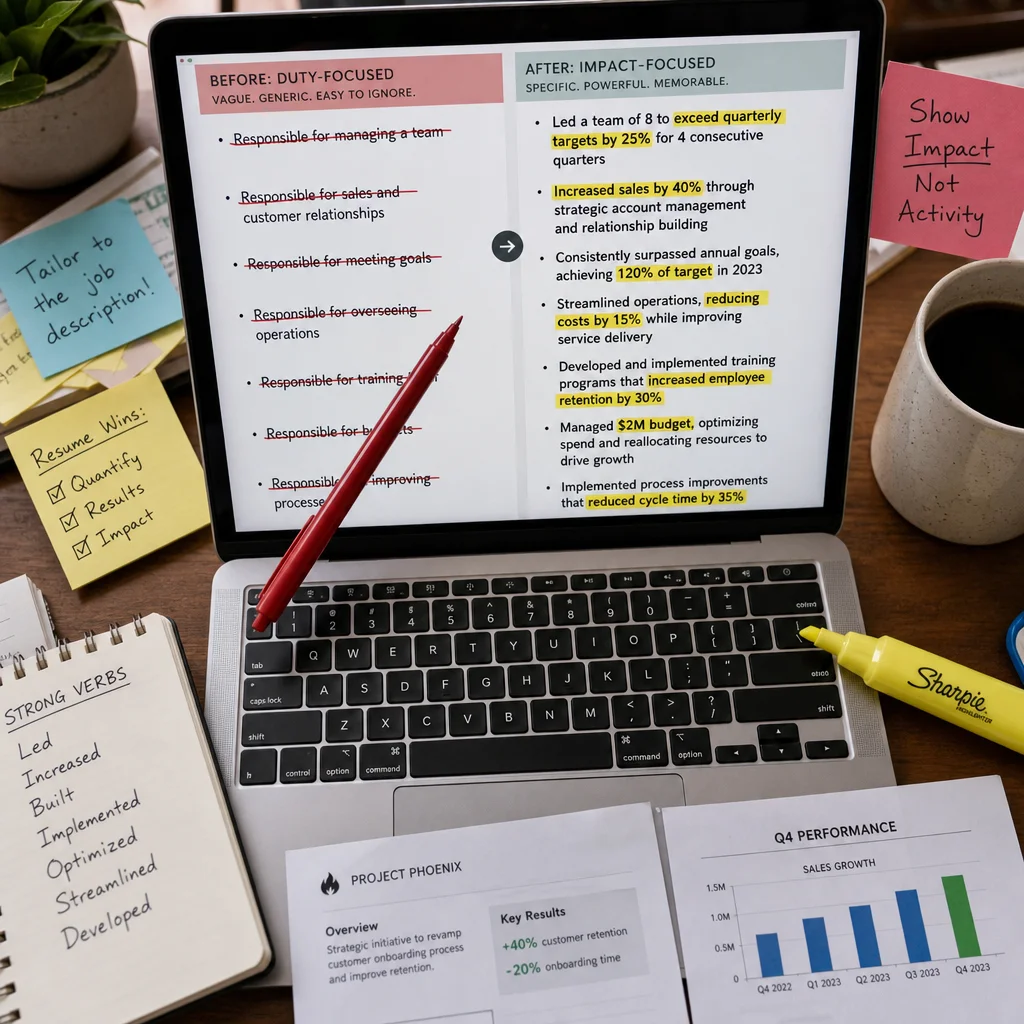
Here’s the hard truth: hiring managers don’t care what you were supposed to do in your internship. They care what you actually achieved.
“Assisted with social media management” is a duty. It tells them nothing.
“Grew Instagram following from 2,000 to 15,000 in 6 months” is an achievement. That gets their attention.
The formula for every bullet point: Action Verb + What You Did + The Result (quantified if possible)
| Weak (Duty) | Strong (Achievement) |
|---|---|
| “Responsible for customer service” | “Resolved 50+ customer issues weekly, maintaining a 95% satisfaction rating” |
| “Helped with data entry” | “Processed 500+ records with 99.9% accuracy, reducing team workload by 15%” |
| “Assisted with event planning” | “Coordinated a 200-person campus event, exceeding attendance targets by 40%” |
This applies to everything - internships, coursework, projects, volunteer work. Employers want to see transferable skills backed by concrete examples (NACE, CA First).
Can’t remember exact numbers? Estimate conservatively. “Approximately 20% increase” beats “significantly improved” every time.
Mirror the Job Description With Your Skills Section
ATS systems scan for keywords. Hiring managers scan for relevance. Your skills section needs to satisfy both.
The strategy: mirror the job description. Read the posting carefully and identify the hard skills mentioned. Then list them in your skills section if you actually have them (Harvard Career Services).
Don’t keyword-stuff. Copying the job description verbatim or listing skills you don’t have is a red flag for human reviewers. It wastes your space and damages your credibility.
Balance hard and soft skills:
- Hard skills: Specific, teachable abilities like Python, Excel, SEO, project management software
- Soft skills: Communication, teamwork, adaptability, problem-solving
For soft skills, don’t just list them - evidence them. “Excellent communication” means nothing. “Delivered 15+ presentations to stakeholders across 3 departments” shows it.
A good skills section structure:
Technical Skills: Python, SQL, Tableau, Microsoft Excel Languages: Spanish (Professional Proficiency) Certifications: Google Analytics Certificate, AWS Cloud Practitioner
The 10-Minute Role-Tailoring Routine:
- Copy the job description into a blank document.
- Highlight every hard skill or requirement mentioned more than once.
- Match each highlighted skill to a concrete proof point from your experience.
- Rewrite your 2–3 line summary using the role’s own language.
- Reorder your skills section so the most relevant skills appear first.
Make Your Education Section Work Harder
Your education section is one of your strongest assets as a new grad. Use it strategically.
The GPA decision framework:
- 3.5+ on a 4.0 scale: Include it
- 3.0–3.4: Include if the job posting requires a minimum GPA
- Below 3.0: Leave it out and let your experience speak
Relevant coursework matters. List 3–5 courses that directly connect to the role:
Good:
BS in Computer Science, State University, 2026 GPA: 3.7/4.0 Relevant Coursework: Data Structures, Machine Learning, Database Systems, Algorithms
Include honors and awards - Dean’s List, scholarships, academic honors. They add credibility when you lack work experience.
What to leave out: High school information (unless it’s truly exceptional), irrelevant extracurriculars, and outdated certifications.
The Soft Skills Employers Actually Want
Employers hiring recent graduates aren’t just looking for academic qualifications. They’re looking for evidence you can work well with others and adapt to their organization (St. John’s University).
The eight soft skills that matter most for new grads:
- Communication - Show it through presentations, writing samples, or client interactions
- Teamwork - Demonstrate through group projects or team-based volunteer work
- Adaptability - Highlight times you learned new tools or navigated change quickly
- Problem-solving - Describe a specific challenge and how you solved it
- Leadership - Even leading a study group or club project counts
- Time management - Juggling coursework, work, and extracurriculars proves this
- Critical thinking - Show how you analyzed data or approached complex problems
- Interpersonal skills - Evidence through customer service or peer mentoring roles
The key: don’t just list them. Show them.
Led a team of 5 in a semester-long consulting project, coordinating weekly meetings and delivering a 40-page report that exceeded professor’s expectations.
That single bullet demonstrates leadership, teamwork, communication, and time management, all at once.

Common Mistakes That Get Graduates Rejected
Avoid these traps that signal “amateur” to hiring managers:
Generic, untailored objective statements. “Seeking a challenging position where I can grow” tells them nothing. Tailor your summary to each role and company (Harvard Career Services).
Unquantified bullet points. Listing duties instead of achievements is the #1 mistake on graduate resumes. Always include numbers, percentages, or specific results where possible.
Keyword stuffing. If you copy entire phrases from the job description, ATS systems will flag it as spam, and human reviewers will see right through it. Use keywords naturally and honestly.
Exceeding one page. You don’t have 20 years of experience. A two-page resume screams “doesn’t follow instructions” before a recruiter reads a single word.
Irrelevant experience. That high school retail job from 5 years ago? Unless it demonstrates transferable skills relevant to your target role, leave it off. Keep everything recent and relevant (St. John’s University).
Fabricating experience. This is the ultimate career killer. You will be caught in the reference check, and even if you’re not, you’ll be caught in the interview when you can’t answer follow-up questions about your “role.”
The Complete Graduate Resume Checklist
Before you hit submit, run through this checklist:
Formatting:
- Single page, standard font, clean layout
- Consistent formatting and alignment throughout
- Skip graphics, tables, and text boxes; ATS systems reject them
- Use PDF format unless the posting says otherwise
Content:
- Write a summary aimed at the specific role and company
- Start each bullet with a strong action verb
- Show impact in every bullet, through numbers or concrete results
- Pull skills keywords straight from the job description
- List GPA (if 3.5 or above) plus relevant coursework under education
- Demonstrate soft skills with examples rather than just naming them
Proofing:
- Zero typos or grammar mistakes; have someone else review it
- Keep verb tense consistent: past for old roles, present for current ones
- Contact info should be current and professional
- Drop pronouns (like “I”, “me”) from bullets
Graduate Resume FAQ (Quick Answers)
Should I include my GPA on my graduate resume?
Include it if it’s at least 3.5 on a 4.0 scale, or if the posting names a minimum. Below 3.0, leave it out and lead with projects, achievements, and relevant experience instead.
How long should a graduate resume be?
One page. Entry-level candidates should expect recruiters to want a concise, scannable single page. If an employer specifically asks for more, follow their instructions.
Should I customize my resume for every application?
At minimum, tailor your summary and skills sections to each role. Mirror the job description’s language naturally and honestly, this is one of the highest-leverage moves you can make in your search.
What if I have no internship experience?
Use academic projects, volunteer work, campus leadership, and part-time jobs to show transferable skills. Quantify outcomes, open with action verbs, and connect what you’ve done to what the employer needs.
Can I use a resume template with graphics?
Skip the graphics. Tables, text boxes, and multi-column layouts are just as risky. ATS parsers struggle to read them, so stick with a clean, standard format and a readable font.
Your Next Steps
A competitive graduate resume takes real work. In a market where 100 applications might draw only 2 responses, that effort separates silence from interviews.
Here’s your action plan:
- Choose the hybrid format and build your one-page foundation
- Tailor your summary for each application. It takes 5 minutes and dramatically increases your chances
- Quantify every bullet point - go back through your experience and add numbers, percentages, and concrete results
- Mirror the job description in your skills section, naturally and honestly
- Proofread, then proofread again - have someone else review your final version
Remember: your resume doesn’t need to be perfect for every role. It needs to be perfect for this role, the one you’re applying to right now.
Use this guide as your resume pillar, then apply the same tailored approach to your cover letter and interview preparation.
Now go build a resume that gets you in the room. The interviews will follow.
About WorkHunt: WorkHunt’s career guides are researched from public guidance published by university career centers and employer-focused organizations, including the sources cited above. We keep our advice practical, evidence-based, and built for real application cycles.

Yuvraj Bajwa
Editorial AuthorFounder, WorkHunt
Yuvraj Bajwa is the founder of WorkHunt, an AI job-search workspace built as part of Coffee Drop Studio. He writes and reviews the resume, cover letter, interview, and application-tracking guidance on this site, drawing on the day-to-day work of building the tailoring, fit analysis, and ATS tools the articles describe.
- Founder
- Product lead