How to Write a Resume Summary That Gets Read in 2026
Use a repeatable 3-step method to write a job-targeted resume summary that hooks recruiters and passes ATS filters, with real before-and-after examples.
By Yuvraj Bajwa, Founder, WorkHunt
July 12, 2026 · Updated October 16, 2026 · 6 min read
2026 Hiring GuideWorkHunt articles are written to help job seekers make better application decisions and are reviewed against our editorial policy.
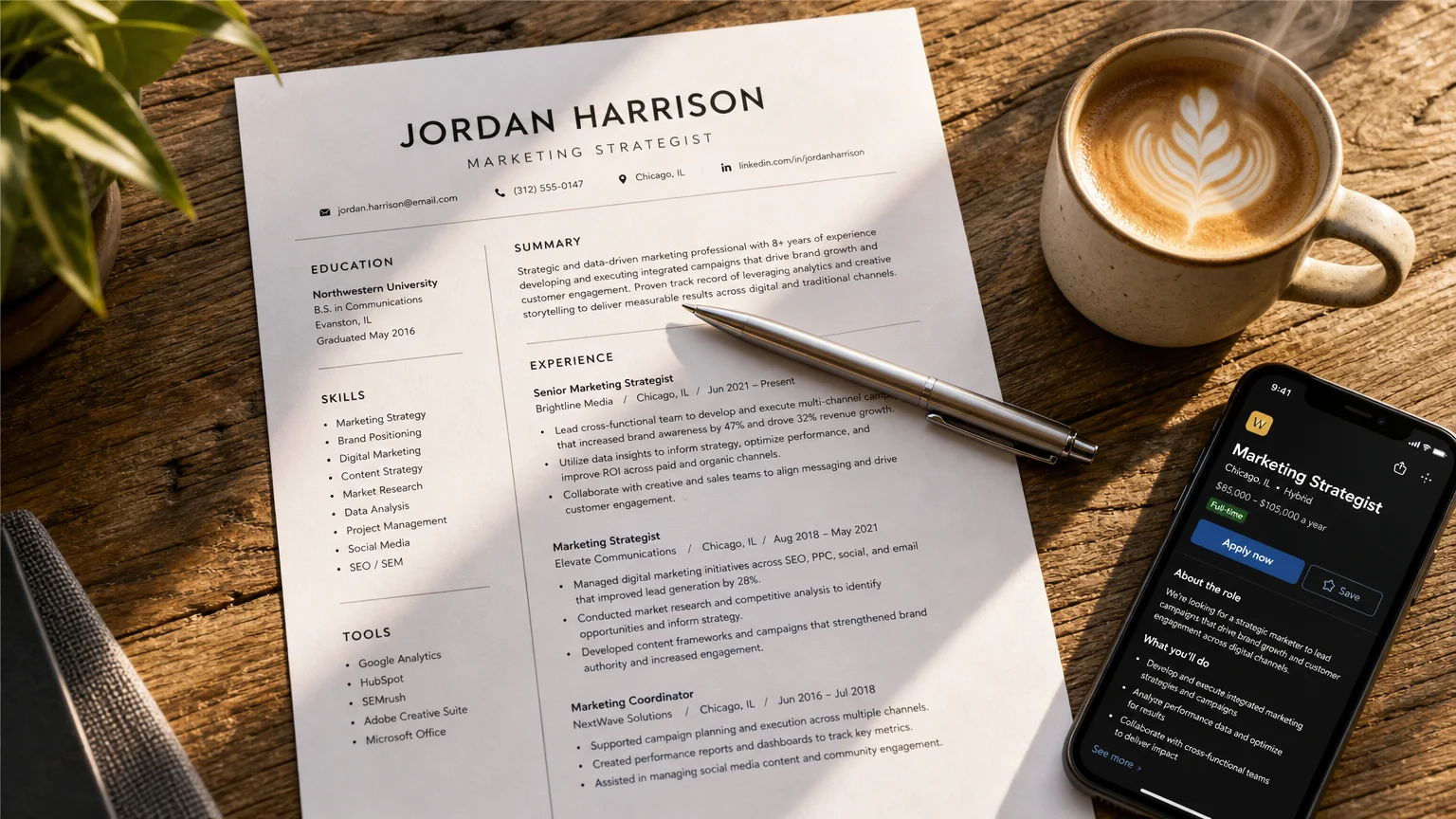
Most people slap a generic summary on their resume and never touch it again.
“I’m a results-oriented professional with 5+ years of experience in project management.”
That kind of summary doesn’t tell recruiters which role you’re after, what you’ve actually done, or why your background lines up with the job. But you can fix it in about 15 minutes using the steps below.
What Is a Resume Summary (And When to Use It)
A resume summary is a short 2-4 sentence “snapshot” near the top of your resume. It puts your strongest qualifications front and center. Recruiters only spend about 6-10 seconds scanning each resume, so that opening section needs to make your fit obvious fast.
Use a summary if: You’re an experienced professional with 3+ years in your field and want to lead with relevant achievements.
Use a short objective instead if: You’re fresh out of school or just starting out with little relevant experience. Objectives talk about what you hope to contribute and learn, not what you’ve already done.
Changing careers? Use a summary, not an objective. It is the one place on the page where you can connect your past work to the new direction: “Project manager moving into product management. Led cross-functional teams to deliver $5M in software projects on time and under budget. Certified Scrum Master, building UX research skills.” See how to write a career change resume for the rest of that resume.
Senior leaders: two lines is often enough. Name your domain and one headline result; the record below does the rest.
Why a Job-Targeted Summary Beats a Generic One
Hiring managers don’t want your whole career story in that opening block. They want to see if your background lines up with the problems listed in the posting.
A targeted summary proves you read the job description and get what the employer needs. It pulls in keywords and required skills straight from the ad, which also helps you clear ATS filters.
Here’s how they compare:
| Generic Summary | Targeted Summary |
|---|---|
| “Experienced marketing professional skilled in digital strategy.” | “Digital marketing specialist who grew organic traffic by 120% in 18 months by optimizing SEO and content strategy.” |
The targeted version leads with metrics (120%, 18 months) and a specific skill (SEO, content strategy). That combo shows what you actually did and how the result connects to the role.
The 3-Step Method for Writing a Targeted Summary
Here’s the framework to run for each application.
Step 1: Deconstruct the Job Description
Open the job description before you write anything. Your task is simple: find the keywords, skills, and themes that show up again and again. Scan for:
- Required technical skills (e.g., “Python,” “SQL,” “Salesforce”)
- Soft skills that get mentioned more than once (e.g., “leadership,” “cross-functional collaboration”)
- Industry-specific language (e.g., “SaaS,” “agile,” “revenue growth”)
- The main responsibilities and what outcomes they expect
Jot down 5-7 terms. Those become your summary’s backbone.
Step 2: Select Your 3 Defining Qualifications
From that list, pick three that line up with your real experience. For each one, attach a concrete achievement. Something with a number, percentage, or dollar amount.
Here’s what you need:
- A title/identity tag: Who are you? (e.g., “Senior Product Manager”)
- 2-3 key skills: What can you do? (e.g., “agile development,” “stakeholder management”)
- A value proposition with metrics: What have you actually pulled off? (e.g., “Increased product adoption by 35% in 6 months”)
Keep every metric honest. If the exact figure escapes you, estimate on the low side. “Approximately 20% increase” still beats “significantly improved” every time.

Step 3: Write 2-4 Sentences Using the Formula
Time to put it together. Just follow this shape:
[Title/Identity] with [X+ years of experience] in [key skill/industry]. Proven track record of [your biggest achievement with metric]. Skilled in [skill 1], [skill 2], and [skill 3]. Seeking to [value proposition for the target role].
Here’s an example, built for a Senior Product Manager role:
“Senior Product Manager with 8+ years of experience in B2B SaaS. Drove 35% adoption growth across 3 product lines by implementing data-driven user research and agile development cycles. Proven expertise in cross-functional stakeholder management and roadmapping. Eager to apply strategic product vision to drive customer retention at [Company Name].”
That’s four sentences, and each one earns its place: a clear role, specific results, relevant skills.
One more, this time for an entry-level marketing position:
“Digital marketing specialist with a degree in Marketing Analytics. Grew Instagram following from 2K to 15K in 6 months by creating targeted content campaigns. Proficient in SEO, Google Analytics, and Meta Ads Manager. Looking to leverage social media growth skills to increase brand awareness at [Company Name].”

Pro Tip: Write the Summary Last
It is tempting to start at the top. Don’t. Write your experience bullets and skills first, then look at which themes keep showing up and summarize those. The result reflects your actual resume instead of a statement of intent.
Then run one test: if you swapped your name for another candidate’s, would the summary still fit them? If yes, it is too generic. Add the specific title, the number, and the target role.
Common Mistakes to Avoid
- Too long. Keep it to 2-4 sentences. Recruiters scan; they don’t read essays.
- Too vague. Saying “Results-oriented team player” tells me nothing. Bring in specific skills and numbers.
- Too self-focused. Don’t just state what you want. Show how you can help them.
- Using first-person pronouns. Never write “I”, “me”, or “my” in a summary. It comes off as awkward and unprofessional.
- Listing duties instead of achievements. Saying “Responsible for social media” is weak. “Grew social reach by 200%” carries weight.
Quick Checklist Before You Hit Send
- The summary is 2-4 sentences (no more than 5)
- It opens with a clear title or identity tag
- It uses keywords from the job description (aim for 2-3)
- At least one metric appears, a number, percentage, or dollar amount
- No first-person pronouns (I, me, my)
- No generic phrases like “team player” or “results-oriented”
- It ends with a value proposition for the target company
Your Summary Is a Short Case for Your Fit
A recruiter gives you 6 seconds. That’s all you get to make them keep reading. So aim the summary straight at the job, back it with real numbers, and cut anything that doesn’t earn its place.
Run the checklist above before you hit send.
Key takeaways:
- Tailor every summary to the exact job description
- Keep it to 2-4 sentences, each carrying concrete metrics
- Open with your title/identity, then close on a value proposition for the company
The rest of your resume should echo that same message. For ready-made versions by experience level, see resume summary examples for every career stage.

Yuvraj Bajwa
Editorial AuthorFounder, WorkHunt
Yuvraj Bajwa is the founder of WorkHunt, an AI job-search workspace built as part of Coffee Drop Studio. He writes and reviews the resume, cover letter, interview, and application-tracking guidance on this site, drawing on the day-to-day work of building the tailoring, fit analysis, and ATS tools the articles describe.
- Founder
- Product lead