5 Resume Must-Haves Recruiters Check in 2026
Recruiters scan your resume in 6 seconds. If these 5 must-have elements are missing, you are out. Learn exactly what to include to pass screening in 2026.
By Yuvraj Bajwa, Founder, Resumae
July 12, 2026 · Updated August 7, 2026 · 6 min read
Resumae articles are written to help job seekers make better application decisions and are reviewed against our editorial policy.

Recruiters spend about 6 seconds on that first pass.
That’s the average window they use to decide whether you move forward. Source
Not nearly enough time to read your life story. They’re just checking whether the required pieces are easy to spot.
Miss one of the five, and your qualifications might not get a fair look.
These aren’t extras. Based on recruiter surveys, hiring data, and first-screen practices, here’s what your resume has to have in 2025.
1. Contact Info That Actually Works
Easy section to overlook.
You need exactly five things here:
- Name (large, clear, at the top)
- Phone number
- Professional email address (no
partyguy99@email.com) - LinkedIn profile URL (customized if possible)
- City and state (not your full street address)
Skip the full home address. A personal website only belongs there if it supports your search, like a portfolio or GitHub.
Why it matters: If a recruiter can’t find your phone number or email within two seconds, they’re gone. They won’t dig around for it. Source
Pro tip: Your LinkedIn profile should match your resume exactly. Different dates, different titles, missing info, any mismatch raises red flags right away.
2. A Tailored Summary (Not a Generic One)
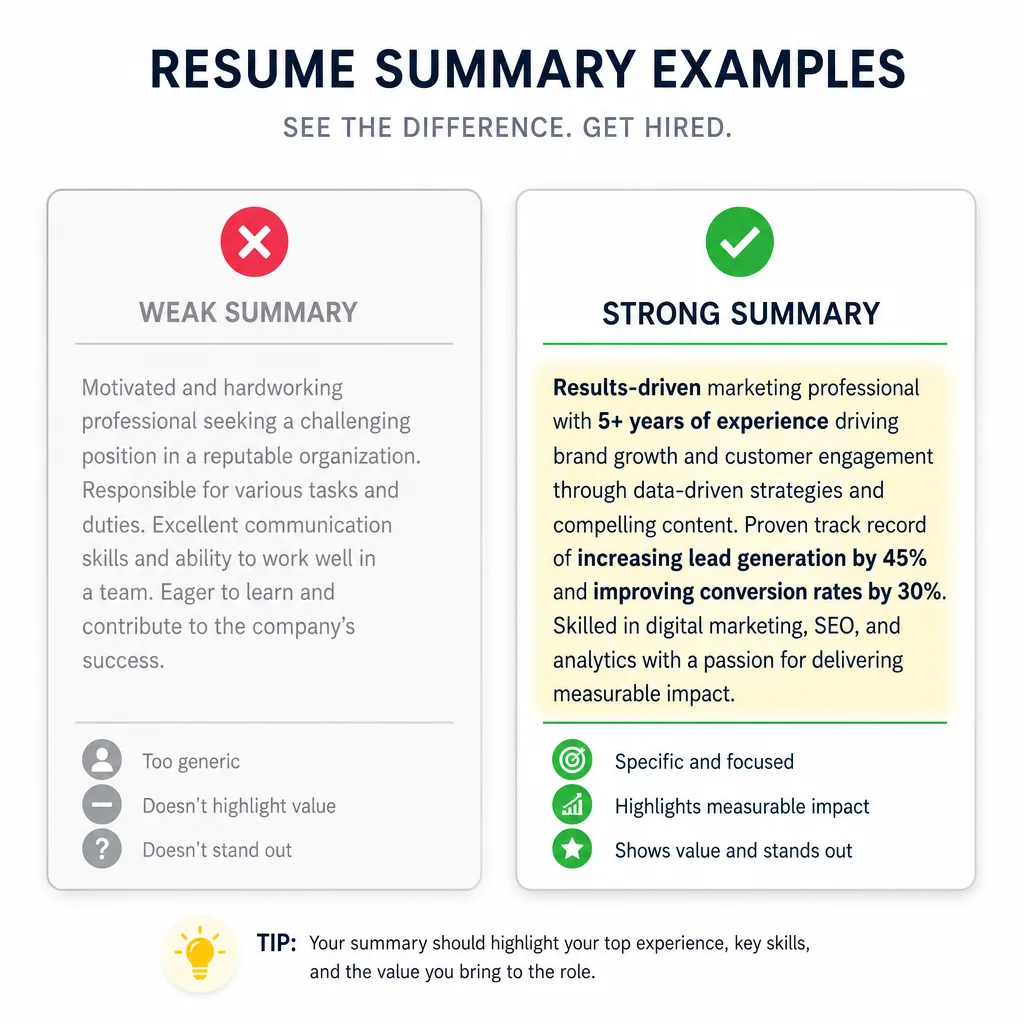
Your professional summary is the first thing a recruiter reads after your name. Make it generic, and they stop reading.
A bad one looks like this:
“Hardworking professional seeking a challenging position where I can utilize my skills and grow with the company.”
That kind of sentence tells them nothing about what you’ve done or the role you want.
A good one looks like this:
“Marketing manager with 7 years of experience driving B2B growth through SEO, content marketing, and paid channels. Increased organic traffic by 150% year-over-year at Company X. Seeking to bring data-driven marketing strategy to a fast-growing SaaS company.”
The second version pulls in job-description keywords, cites a real result (a 150% traffic increase), and names the type of company it’s aimed at.
Why it matters: Recruiters scan summaries to see if you fit the role. If your summary does not match the job description keywords, you are invisible to both ATS systems and human eyes. Source
Pro tip: Write a new summary for every job application. It takes 5 minutes and dramatically increases your chances of getting noticed. Tailored resumes are 3x more likely to land interviews than generic ones.
3. Quantified Work Experience (Reverse Chronological)
This section gives recruiters evidence of your impact.
Your work experience should list your most recent job first and go backward. Each bullet point should focus on what you achieved, not what you were responsible for.
Use this formula:
[Action verb] + [what you did] + [the result, quantified]
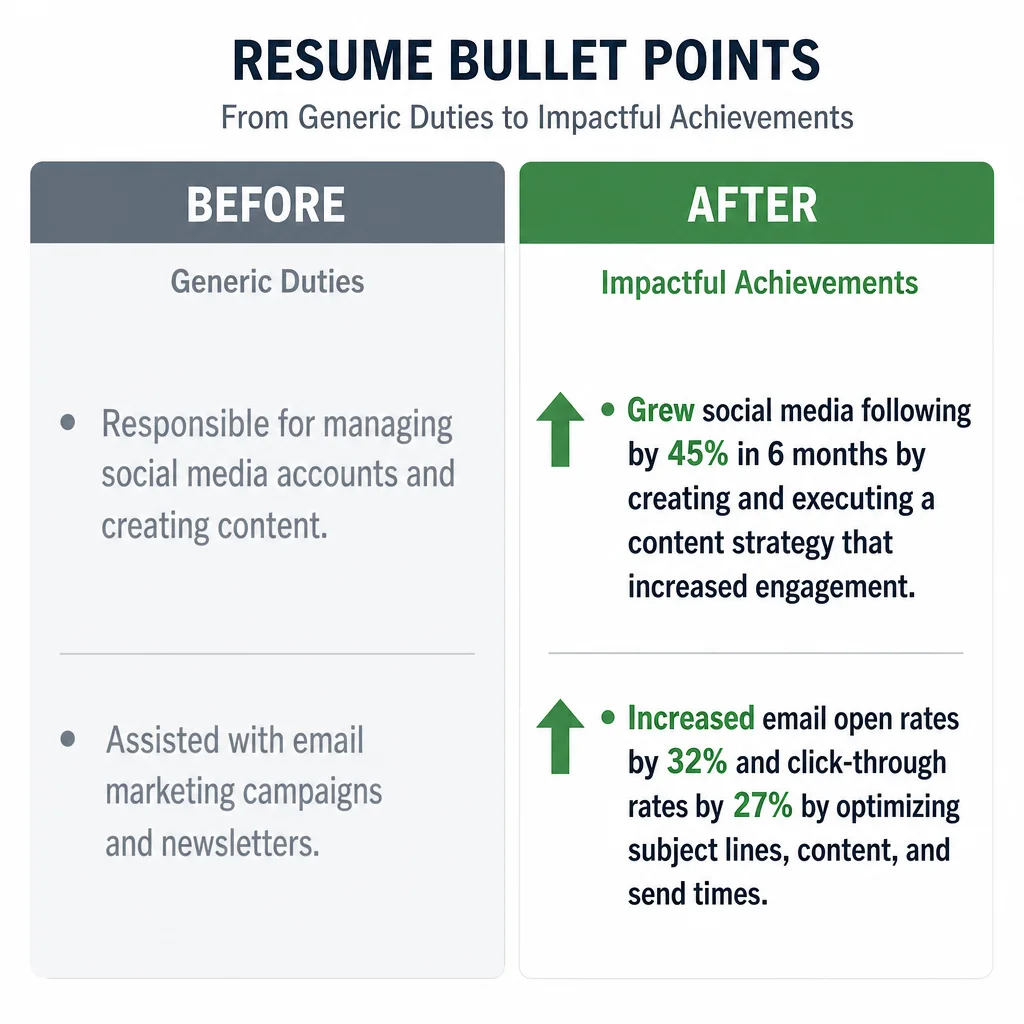
Bad bullet points read like a job description:
- “Responsible for managing social media accounts”
- “Handled customer service inquiries”
- “Assisted with project management”
Good bullet points read like proof of impact:
- “Grew Instagram following from 2,000 to 15,000 in 6 months through organic content strategy”
- “Resolved 50+ customer inquiries daily with a 95% satisfaction rate”
- “Led a cross-functional team of 8 to deliver a $2M project 3 weeks ahead of schedule”
Why it matters: Quantified achievements are the #1 differentiator recruiters look for in work experience bullet points. Numbers catch the eye. They make vague claims believable.
Hiring managers are looking for five specific things when they scan this section: education, organization (work history), growth trajectory, quantifiable data, and grammar/presentation. Source
Pro tip: If you don’t know the exact number, estimate conservatively. “Reduced costs by approximately 15%” is better than “Reduced costs significantly.”
4. A Skills Section Aligned to the Job Description
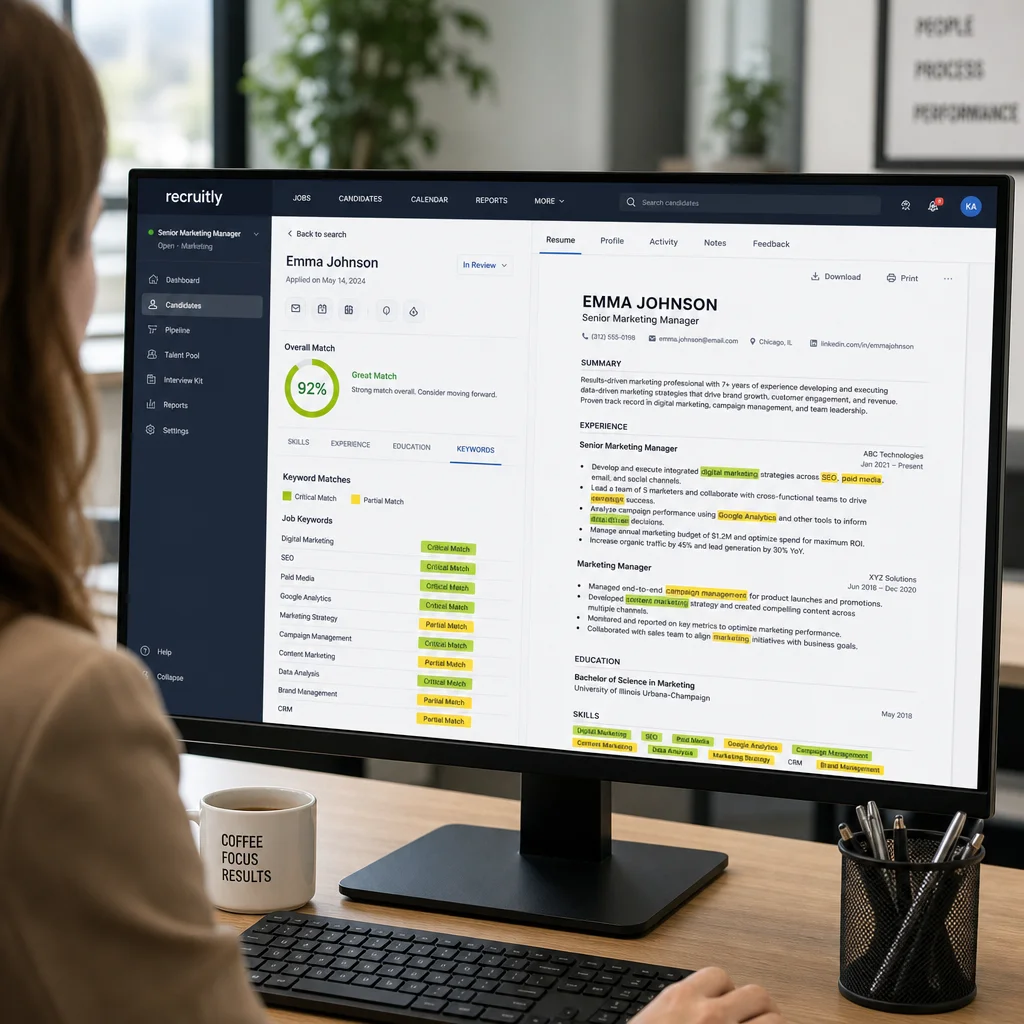
Your skills section isn’t a catch-all for every tool you’ve touched. It’s a focused list of the hard skills and keywords the job description actually asks for. Recruiters scan for specifics, and written communication skills, initiative, strong work ethic, and technical skills. According to NACE research, 70%+ of employers say these attributes matter most when they’re reviewing resumes.
Use the same language the job description uses, but only where it genuinely describes what you’ve done. If the posting says “project management” and your resume says “program coordination”, an ATS might never make the connection.
Structure your skills section like this:
| Hard Skills (ATS Keywords) | Soft Skills (Show, Don’t Tell) |
|---|---|
| Project Management | Written Communication |
| Salesforce CRM | Cross-functional Collaboration |
| SQL & Python | Problem-solving |
| Google Analytics | Time Management |
Why it matters: Your resume has to be ATS-friendly first and human-friendly second. If the ATS can’t find matching keywords, no human ever sees it.
Pro tip: Only include skills you can actually talk about in an interview. Put down “Python” and the interviewer asks you to walk through a Python script. You better be ready.
5. Education & Certifications (With Relevant Context)
This one’s simple, but people still manage to overthink it. List your degree in full, no abbreviations, along with the institution and graduation year (or expected year). Add any certifications that matter for the role you’re targeting. If your degree doesn’t line up with the job, like a history major going for marketing, don’t stress. Put it down anyway. Your experience and skills will do the heavy lifting.
Got certifications? List them. For certain roles, they matter more than a degree. A credential like PMP, Google Analytics certification, AWS, or something industry-specific can set you apart.
Pro tip: If your GPA is 3.5 or higher and you recently graduated, include it. Otherwise, skip it.
The One Thing That Ties All Five Together
Even with all five elements in place, you might still hear nothing back. The missing piece? Tailoring.
Send the same resume to every job and it reads as generic. Recruiters can tell when an application wasn’t written for the role.
The market in 2025 is tough. The people getting interviews are the ones who spend the extra 15 minutes on three small moves:
- Swap summary keywords so they match the job description
- Reorder skills so the most relevant ones sit on top
- Rework bullet points to spotlight the achievements that matter most
It’s not complicated, just effort.
Before you send another application, open your resume and run through those five elements. Fix whatever’s missing.
That alone makes the recruiter’s first pass a lot easier.
This article was written by the career experts at Resumae, with decades of combined experience in resume writing and job coaching.

About the author
Yuvraj Bajwa
Founder, Resumae
Yuvraj Bajwa is the founder of Resumae, an AI job-search workspace built as part of Coffee Drop Studio. He writes and reviews the resume, cover letter, interview, and application-tracking guidance on this site, drawing on the day-to-day work of building the tailoring, fit analysis, and ATS tools the articles describe.
- Founder
- Product lead
Related reading
Graduate Resume Guide: Win Entry-Level Jobs in 2026
Evidence-based graduate resume strategies to turn limited experience into quantified, ATS-friendly wins that earn interviews.
How to Write a Resume Summary That Gets Read in 2026
Use a repeatable 3-step method to write a job-targeted resume summary that hooks recruiters and passes ATS filters, with real before-and-after examples.
5 Resume Mistakes That Get You Rejected and How to Fix Them
Stop getting ghosted in 2026. Fix these 5 resume mistakes — typos, ATS errors, and weak bullets — that block interviews and how to correct them fast.
Next step
Ready to build a resume that gets noticed?
Paste a job description and let AI tailor your resume - free plan, no credit card required.