How to Write a Career Change Resume That Gets Noticed
Write a career change resume that gets interviews without direct experience: pick the right format, map transferable skills, and use the new field's terms.
By Yuvraj Bajwa, Founder, WorkHunt
August 10, 2026 · Updated October 16, 2026 · 9 min read
2026 Hiring GuideWorkHunt articles are written to help job seekers make better application decisions and are reviewed against our editorial policy.

Your resume lists job titles in chronological order, and that is the problem. Those titles say “retail manager” when you are applying for “project coordinator”. You know you can do the job, but the recruiter sees a mismatch and moves on before reading further.
A traditional chronological resume works against career changers because it leads with exactly what makes you look like a poor fit: old titles and another industry’s timeline (Wharton Executive Education). This guide rebuilds the resume around what you can do, including when you have no direct experience in the new field.
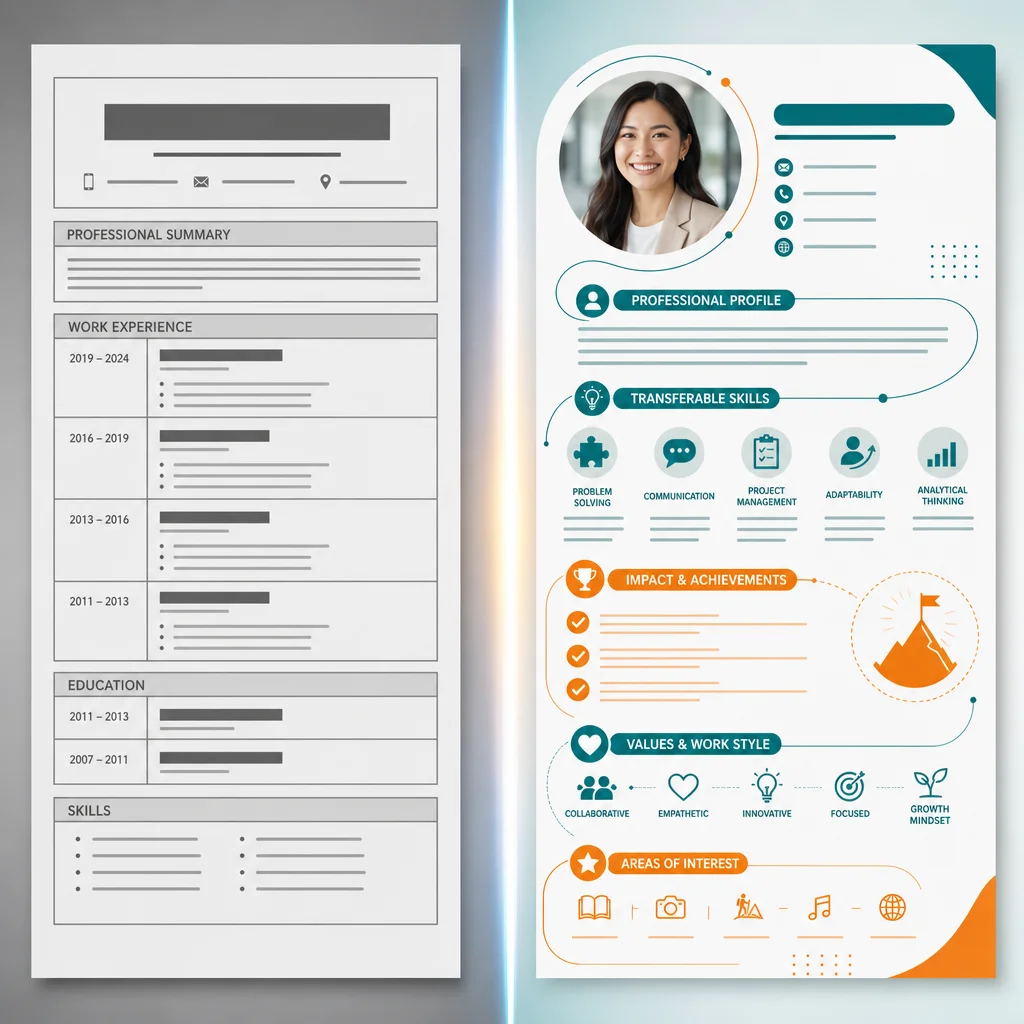
Why a chronological resume fails career changers
In the first few seconds, recruiters check your most recent title, your employers, and your dates. If none of them match the role, they assume you are not qualified.
Your titles and industry become roadblocks instead of selling points (The Interview Guys). A hospitality manager moving into operations is not unqualified, but a resume that opens with “Restaurant General Manager” will not tell a tech recruiter that. You need a structure that lets you control the story.
Step 1: Choose the right format
Two formats work for most career changers:
- Functional resume: almost all the emphasis is on skills and achievements, with a brief work history at the bottom. It suits a very large shift where past titles say little.
- Combination (hybrid) resume: a strong summary and skills section first, then a standard work history. For most career changers this works better, because it shows transferable skills and still proves a real track record (University of Northwestern - St. Paul, SNHU Career360).
A purely functional resume can raise suspicion that you are hiding gaps or job-hopping (Indeed). Unless you have a long gap or are entering the workforce for the first time, use a combination resume.
Step 2: Lead with a summary that frames the transition
The summary is the first thing read after your name. Use it to tell the story of the move, presenting your past experience as the foundation for the new role.
A reliable formula:
- The target title (“Project Coordinator”)
- Your experience (“with 5+ years leading operations”)
- Your most relevant transferable skills (“in team leadership and process improvement”)
- A proof point (“managed a $2M annual budget”)
Example: “Project coordinator with 5+ years leading operations teams. Streamlined workflows, managed budgets above $2M, and kept cross-functional groups at 99% on-time delivery. Bringing that organization and communication to project delivery in a fast-paced tech environment.”
Before: “Retail Store Manager with 10 years of experience. Responsible for daily operations, staff scheduling, inventory, and customer service.”
After: “Project Coordinator with 10 years of operations leadership. Manage daily workflows across a 25-person team, coordinate vendor contracts, and keep inventory accuracy above 99%.”
Three lines that say who you are, what you are good at, and what you want (Excelsior OWL, Monster). Keep it confident and forward-looking; do not over-explain why you are switching.
Step 3: Build a transferable skills section that maps to the role
This section is the core of a career-change resume. Think of it as a skills transferability matrix: you map what you have done onto what the new job asks for, instead of just listing abilities (The Interview Guys).
- List the top five to seven skills from the job description.
- For each one, find a concrete example from your past.
- Write a bullet that shows the skill with a result.
Moving from teaching to corporate training, where the posting asks for “curriculum development” and “public speaking”, might look like this:
| Transferable skill | How you have shown it |
|---|---|
| Curriculum development | Created and rolled out an 8-week math curriculum for 120+ students, raising average test scores by 15% |
| Public speaking and facilitation | Presented daily to groups of 30+; ran parent-teacher conferences for 200+ families a year |
| Data analysis | Used student performance data to find learning gaps and adjust instruction, lifting the class pass rate by 10% |
Transferable skills can come from anywhere: paid work, volunteering, internships, or personal projects (UPenn Career Services, BetterUp). Running a charity fundraiser is project management. Label it as volunteer work and describe the scope; it still counts.

Step 4: Reframe your experience in the new field’s language
You are not exaggerating. You are describing what you did in terms the new industry recognizes. A project manager moving into marketing could rewrite:
| Original bullet | Reframed for marketing |
|---|---|
| “Managed project timelines and budgets” | “Led end-to-end campaign delivery with budgets up to $500K” |
| “Analyzed project data to improve efficiency” | “Used data analysis to improve campaign ROI by 25%” |
| “Coordinated with multiple teams and stakeholders” | “Aligned creative, development, and executive teams on brand messaging” |
The work did not change; the wording did, and the relevance becomes obvious (University of Phoenix). Quantify wherever you can: “Managed a $2M budget across 15 concurrent projects” beats “Managed a large budget”.
Step 5: Prove the new skills with a projects section
A skills section makes claims; a projects section proves them. This matters most when moving into tech, design, or data, where your past roles do not show the new skills directly (Story CV). A retail manager cannot prove SQL through store experience, but a course project can.
Good material for this section:
- Personal projects that show the skills you claim
- Freelance or side work
- Substantial coursework or certification projects
- Volunteer work that used the relevant skills
Example (moving into UX design):
Mobile App Redesign (Personal Project)
- Ran 10+ user interviews and usability tests to find pain points in a local business’s booking app
- Built wireframes and interactive prototypes in Figma
- Reworked the booking flow, cutting average booking time from 4 minutes to under 2 in testing
It shows the skill and the initiative: instead of waiting for the job, you went and learned.
Step 6: Use the posting’s keywords to get past the ATS
Applicant tracking systems compare your resume with the job description, and recruiters search them using the posting’s terms. Without the right terms, a career changer’s resume rarely surfaces.
- Copy the job description for the role you want.
- Highlight the hard skills it names, such as “project management”, “agile”, or “SQL”.
- Use those terms in your summary, skills, and experience sections, only where they honestly apply.
If the job asks for “stakeholder management” and you managed vendor relationships, write “stakeholder management” instead of “managed vendors”. That is not stretching the truth; it is using the new industry’s vocabulary for work you did.
Do not stuff keywords. “Data analysis” in every other bullet reads as if a bot wrote it. Use the terms naturally and prioritize the ones the posting repeats.
Step 7: Handle your work history and gaps honestly
A career change raises questions: why leave your old field, and can you do the new one? Answer them briefly and early.
Do not hide your work history; reframe it. In the experience section, list the projects you ran and results you got, not what a typical “Store Manager” does. You do not need every job you have held: the most recent two or three roles that show transferable skills are usually enough, with older roles summarized in a line or left off.
Address the move itself in the cover letter or a short line in the summary, framed as a deliberate step toward the new field rather than an escape from the old one (Herzing University).
If there is a gap, say what you did with the time, briefly: “Took a sabbatical to earn a certification in X” or “Cared for a family member while completing online courses in Y”.
Templates for common career changes
Teacher to corporate trainer
Summary: Educator with 8+ years of curriculum design, instruction, and assessment. Skilled at breaking down complex topics, facilitating group learning, and building training materials. Moving that instructional expertise into corporate training.
Skills: Curriculum Development, Public Speaking and Facilitation, Instructional Technology (Google Classroom, Zoom), Assessment and Performance Evaluation
Relevant experience:
- Developed and delivered 200+ lessons for mixed-ability learner groups
- Improved student comprehension 30% with new visual aids
- Helped design and roll out a district-wide digital learning initiative
Sales associate to project coordinator
Summary: Client-focused sales professional with 5+ years managing accounts and coordinating schedules. Consistently meets deadlines, resolves client issues, and supports cross-functional teams. Seeking a project coordinator role.
Skills: Client Relationship Management, Task and Schedule Coordination, CRM Systems (Salesforce), Reporting and Documentation
Relevant experience:
- Managed schedules and follow-ups for 40+ active client accounts
- Resolved 95% of escalated client issues within 24 hours
- Coordinated product demos with internal teams, improving conversion by 15%
Mistakes career changers make
- A generic objective. “Looking for a challenging position that uses my skills” says nothing. Use the targeted summary instead.
- Listing every job. The barista job from ten years ago does not help. Focus on the last 10 to 15 years and condense the rest.
- Weak verbs. “Responsible for” and “Helped with” are passive. Use “Led”, “Launched”, “Created”, “Improved”, “Negotiated”.
- An unproven skills list. “Communication” and “Leadership” with no evidence waste space. Show how you used them.
- Ignoring the ATS. If you apply online, the posting’s terms need to be on the page.
Career change resume checklist
- Combination format, not purely chronological
- Summary frames the transition and names your key transferable skills
- Transferable skills section maps past experience to the new role’s requirements
- Experience rewritten in the new field’s language, with numbers
- Projects or certifications section proves the new skills
- Keywords from the posting, used naturally
- Gaps addressed briefly and honestly
- Every bullet starts with a strong action verb
- The whole resume can be scanned in well under 30 seconds
Frequently asked questions
How do I write a resume when switching careers without relevant experience?
Lead with transferable skills, not job titles. Read the job description to find the skills it asks for, use a combination format with a skills summary first, reframe past achievements in the new industry’s language, and add projects or certifications that prove the new skills.
Which resume format works best for a career change?
A combination (hybrid) resume. It puts the summary and transferable skills first while still showing a clear work history. Use a functional resume only with large gaps or when entering the workforce for the first time.
Should I leave some jobs off my career-change resume?
Yes. Include the most recent two or three roles, prioritizing ones where you can show transferable skills. If an older job adds nothing to the new direction, leave it off or summarize it in a line.
What are good transferable skills for a career change?
Communication, project management, leadership, data analysis, budget management, stakeholder management, curriculum design, and process improvement. Each needs a concrete, measurable example.
How should I handle an employment gap during a career change?
Briefly and honestly. Say what you did, such as certification, freelance work, volunteering, or caregiving, then point to the skills you gained and how they connect to the role.
The bottom line
Stop leading with where you have been and start leading with what you can do. A combination format, a summary that frames the move, a transferable skills section, and the new field’s vocabulary give you a real chance of getting past the screen and into the interview.
WorkHunt compares your resume with each job description and shows which of your skills already match and which need to be reframed, so every application to the new field is tailored rather than generic. Start with how to tailor your resume.

Yuvraj Bajwa
Editorial AuthorFounder, WorkHunt
Yuvraj Bajwa is the founder of WorkHunt, an AI job-search workspace built as part of Coffee Drop Studio. He writes and reviews the resume, cover letter, interview, and application-tracking guidance on this site, drawing on the day-to-day work of building the tailoring, fit analysis, and ATS tools the articles describe.
- Founder
- Product lead