Resume Builder vs Tailoring Tool: Do You Need Both?
Need a resume builder or tailoring tool in 2026? See what each does, why ATS match matters, and the workflow that gets your resume read faster.
By Yuvraj Bajwa, Founder, Resumae
August 10, 2026 · 8 min read
Resumae articles are written to help job seekers make better application decisions and are reviewed against our editorial policy.
Last updated: August 10, 2026 · Read time: 7 minutes
Your resume exists. Maybe a flashy tool built it, one that promised ATS compatibility. Interviews still aren’t showing up.
Short answer: Both. The builder gives you a clean, ATS-friendly base document. The tailoring tool, or a simple manual process, adapts that base for each specific job. Foundation gets you read; tailoring gets you ranked.
Most job seekers are attacking the wrong problem. They polish formatting until it gleams, when the actual question is whether the resume matches the role in front of them.
Those are two separate issues. Two separate tools handle them.
Here’s what each does, why neither works alone, and how to build a workflow that gets a human to actually read your resume.
The Formatting Problem: What Resume Builders Actually Do
Structure is what resume builders solve. Their whole purpose is keeping your document from getting auto-discarded because it’s a mess.
A resume builder is the foundation of your job search house. It manages the dull but essential parts:
- Templates and layout design that follow standard hiring conventions
- Proper formatting across sections like work history, education, and skills
- ATS-parseable output so applicant tracking systems can read your information correctly
This carries more weight than you’d guess. A complex table, an unusual font, or a creative layout that confuses an ATS makes your carefully crafted experience invisible. The system simply can’t pull your details into its database.
But the critical catch: A resume builder makes your resume clean, not relevant. You get a universal document, one-size-fits-all by design. Job applications aren’t one-size-fits-all.
The Relevance Problem: What Tailoring Tools Do
Tailoring tools tackle an entirely different issue: relevance.
When you apply for a job, a tailoring tool reads the specific description and helps you adjust your resume to fit it. These tools help you:
- Choose keywords that match what the posting actually asks for
- Rearrange sections so the most relevant details surface first
- Reframe your summary around the employer’s priorities
- Feature achievements that map directly to the role’s demands
The difference is simple: builders polish how your resume looks, while tailoring tools refine what it says.
And what it says is what gets you noticed.
The ATS Reality: Why Match Beats Format Every Time
This is where most people get stuck. They think a resume that parses cleanly through an ATS has done its job. That’s only half the story.
Two resumes can be read perfectly by the same system, every field captured, no data lost, and still land in completely different places afterward. The deciding factor is keyword match.
Here’s a telling example: in a direct comparison, two resumes with identical ATS parse rates scored roughly 35% apart in keyword match, simply because one had been tailored to the job description and the other hadn’t.
That gap matters. ATS platforms rank candidates by how closely they align with the posting’s requirements. A 35% swing isn’t a small edge. It can separate someone in the top 10 from someone sitting at number 45.
The systems themselves have evolved too. They’re not just matching exact phrases anymore. Modern ATS keyword detection zeroes in on usable skills, concrete actions, tools, credentials, and languages, not on cramming “management” or “leadership” into your resume 15 times and hoping it sticks.
Bottom line: a clean resume gets you read. A tailored one gets you ranked.
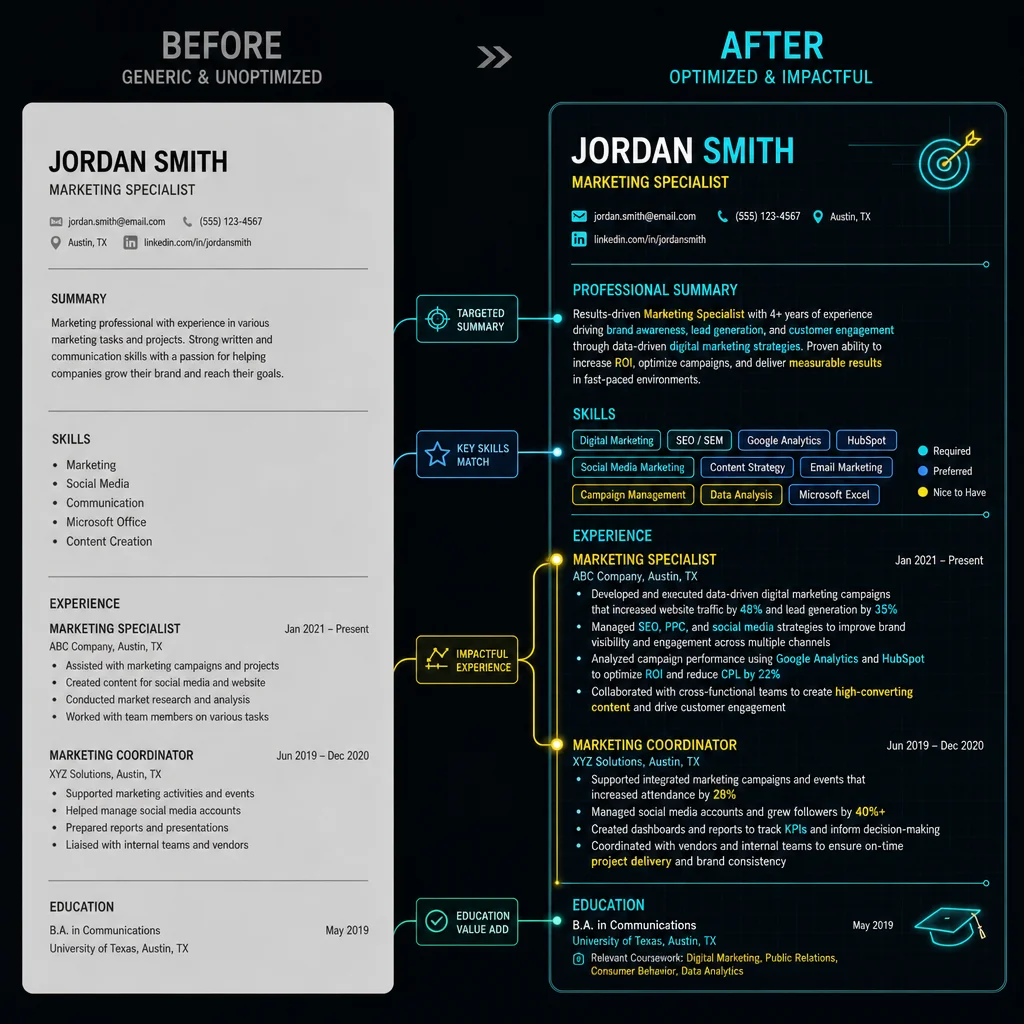
What Tailoring Looks Like in Practice
Here’s how that plays out for a real candidate.
A marketing coordinator is going for a “Growth Marketing Specialist” position. Their master resume reads:
Managed social media accounts and created content for the company blog.
The tailored version, using the same facts, reads:
Owned Instagram and LinkedIn strategy, growing engaged followers 28% in six months; partnered with the product team to launch three campaigns that drove 1,200+ qualified signups.
Same facts. Different emphasis. The tailored version leads with outcomes the employer asked for, uses the language of the job description, and puts the most relevant achievement first.
That’s the difference between a generic document and a targeted pitch.
The Human Factor: Recruiters Notice Tailored Resumes
Let’s move beyond the algorithms. Because at the end of every automated screening process, there’s a human being with a stack of resumes and 30 seconds of attention for each one.
Those humans strongly prefer tailored resumes. The numbers are consistent across multiple surveys:
- 61% of hiring managers say a tailored resume is the best way for candidates to improve their chances
- 83% of recruiters are more likely to hire candidates who customized their resume to the specific job
- Tailored resumes can increase your chances of getting an interview by up to 115% compared to sending out the same generic resume every time
Think about what 115% means in practical terms. If you were getting one callback for every 10 applications before, you could potentially get two for every 10 after tailoring. That’s the difference between a slow, demoralizing job search and one that’s actually moving forward.
The Complementary Workflow: Build Once, Tailor Per Application
So which tool do you need?
The answer is both. And asking which one is “better” is asking the wrong question.
These tools serve different stages of the same workflow:
Stage 1: Build a solid foundation. Use a resume builder to create a clean, well-structured, ATS-friendly master resume. This is your baseline, the document that gets your foot in the door and ensures you don’t get eliminated on formatting technicalities.
Stage 2: Tailor for each application. Before sending your resume for a new position, put it through a tailoring process, whether that means using a digital tool or working from a manual checklist. Adjust keywords, reorder content, and highlight the accomplishments that match what that specific employer is looking for.
Stage 3: Review and refine. Once you’ve tailored the resume, do a final pass. Make sure the changes feel natural and don’t undermine the clean structure you built in stage one.
This workflow takes more time per application. But it transforms the quality of each one you send.
How to Choose: When a Builder Alone Is Enough vs. When You Need Tailoring
You can probably use a builder alone if:
- You don’t have a resume yet and need a base document quickly.
- You have a strong resume and you’re applying to the same exact role with identical requirements every time.
You need builder + tailoring if:
- You’re applying to varied positions, even in the same industry.
- You’ve sent 20+ applications with no callbacks, your generic approach isn’t working.
- You’re targeting a competitive field with many qualified applicants, every edge counts.
As a rule of thumb: If every application is the same document with the same content, you’re gambling on a single resume matching dozens of different requirements. Sometimes you’ll win. Most of the time, you won’t.
Practical Tailoring Tips You Can Use Today
Before you reach for another tool or template, here are the core tailoring moves that actually make a difference:
Review the job description, line by line. Circle the skills, experiences, and qualifications they mention more than once. These are the signals that matter most to the employer.
Compare your resume to their requirements. Where do you match? Where are the gaps? Your tailored resume should address the matches directly and any potential concerns proactively.
Update your professional summary. This is prime real estate. Rewrite it to echo the language of the specific job description, not just your generic professional brand.
Customize your work history. Reorder your bullet points so the most relevant achievements come first. You don’t have to remove other experience, but you should prioritize what matters most for this particular role.
Include measurable results. Numbers beat adjectives every time. “Reduced costs by 15%” consistently outperforms “responsible for cost reduction”. Say what you achieved, not just what your job description said.
Don’t just dump keywords in.
Work them naturally into your bullets and summary. Modern ATS systems detect stuffing, and human recruiters will spot it too.

Resume Tools Worth Considering
You can skip the dozen-tool approach. What you actually need: one solid builder for a foundation, and one tailoring tool (or a manual checklist) for each job.
Resume builders worth evaluating:
- Rezi — it pushes AI-powered content and ATS-friendly designs. A fast way to build a clean master resume.
- Zety — polished templates and content prompts make this a good pick if you want hands-on design control.
- Resume.io — template quality paired with step-by-step help. Offers a solid speed-and-customization mix.
Tailoring tools worth evaluating:
- Jobscan — the standard for comparing a resume against a specific job description. Finds keyword gaps before you submit.
- Teal — combines drafting with a tailoring dashboard. Handy if you run several applications at once.
- Resume Worded — scores your resume for a target role and suggests what to fix first.
Many of these tools have free options or trials. Start free. Run a real application through the workflow. Only pay if the tool saves you time or delivers better results.
The Bottom Line
A single resume has to solve two separate problems.
Problem one: readability, clean structure, clear formatting, ATS compatibility. That’s the builder’s domain.
Problem two: relevance, the document must prove within the first 30 seconds that you respond directly to what this employer needs. That’s the tailoring tool’s job.
Build once. Tailor every time.
If you generate one version and send it everywhere, you do not have a strategy; you have a lottery ticket. The numbers do not mince words: tailored resumes get read, ranked faster, and bring in interview calls.
Start with a builder to lay a solid foundation. Then make tailoring a mandatory step in your application process. Your resume isn’t something you write once and reuse endlessly. It’s a tool you sharpen for each opportunity. Treat it that way, and you’ll notice the change in how often you hear back.
What’s your biggest resume frustration right now, getting past the ATS, or making your experience match the job? Drop your question in the comments, explore more resume guides in the Resumae blog, and share this guide with someone who’s job hunting.

About the author
Yuvraj Bajwa
Founder, Resumae
Yuvraj Bajwa is the founder of Resumae, an AI job-search workspace built as part of Coffee Drop Studio. He writes and reviews the resume, cover letter, interview, and application-tracking guidance on this site, drawing on the day-to-day work of building the tailoring, fit analysis, and ATS tools the articles describe.
- Founder
- Product lead
Related reading
Does Tailoring Your Resume Really Matter for ATS?
Learn the truth about ATS resume screening, why tailoring genuinely improves your chances, and how to customize efficiently without rewriting from scratch.
Sent 50 Resumes & Got Zero Callbacks: What Am I Doing Wrong?
Zero callbacks after 50 applications is fixable. See the real reasons your resume is being ignored and fix your next 50 applications.
How to Tailor Your Resume for ATS: 5-Step Guide
Tailor your resume for ATS and land more interviews. Follow this 5-step guide on keywords, formatting, and match rates for an ATS-proof resume in 2026.
Next step
Ready to build a resume that gets noticed?
Paste a job description and let AI tailor your resume - free plan, no credit card required.