Ultimate Resume Guide 2026: Pass ATS and Impress Recruiters
Master resume format, keywords, and strategies to stand out in 2026. Get ATS tips, achievement bullets, and a step-by-step template to get hired faster.
By Yuvraj Bajwa, Founder, Resumae
July 3, 2026 · Updated August 7, 2026 · 5 min read
Resumae articles are written to help job seekers make better application decisions and are reviewed against our editorial policy.
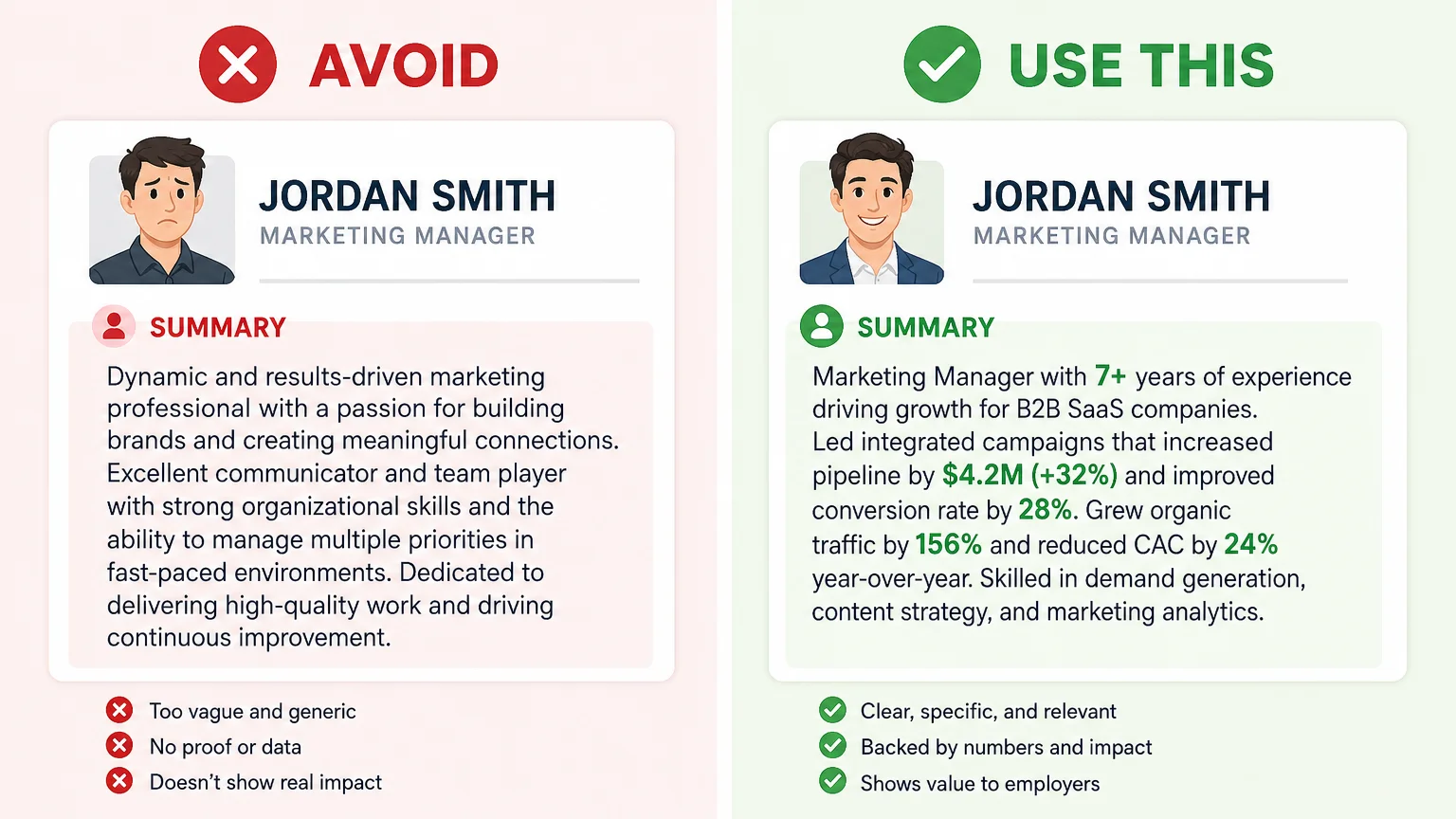
1. Ditch the “Objective”: write a 3-line summary instead
Right under your name, that resume summary is prime real estate. It’s where you get to say what you do, how long you’ve done it, and the one result that matters most.
Old way: “Motivated professional seeking a challenging position in a dynamic organization where I can leverage my skills…”
New way: “Marketing Manager with 7 years of experience in B2B SaaS. Grew pipeline by 300% at two startups. Certified HubSpot expert.”
Keep it to three lines. Numbers and specifics beat vague adjectives.
Here’s what to include:
- Your role + years of experience
- One major result or specialty
- A relevant credential or skill (if it helps)
Pro tip: Don’t say “seeking an opportunity.” That’s obvious. Instead, lead with who you are and what you’ve done.
2. Use the “Duty vs. Achievement” Switch on Every Bullet Point
Job duties. That’s what most resumes are stuffed with. But hiring managers aren’t reading for duties. They want achievements.
| Weak (Duty) | Strong (Achievement) |
|---|---|
| “Responsible for social media" | "Grew Instagram from 2K to 15K followers in 6 months" |
| "Managed a team" | "Led a team of 5, delivering projects 30% faster" |
| "Handled customer complaints" | "Resolved 50+ tickets daily with 95% satisfaction rate” |
The pattern is simple: verb, number, result. If you’re not sure about the exact number, estimate. “Approximately 20% increase” beats “significantly improved” every time.
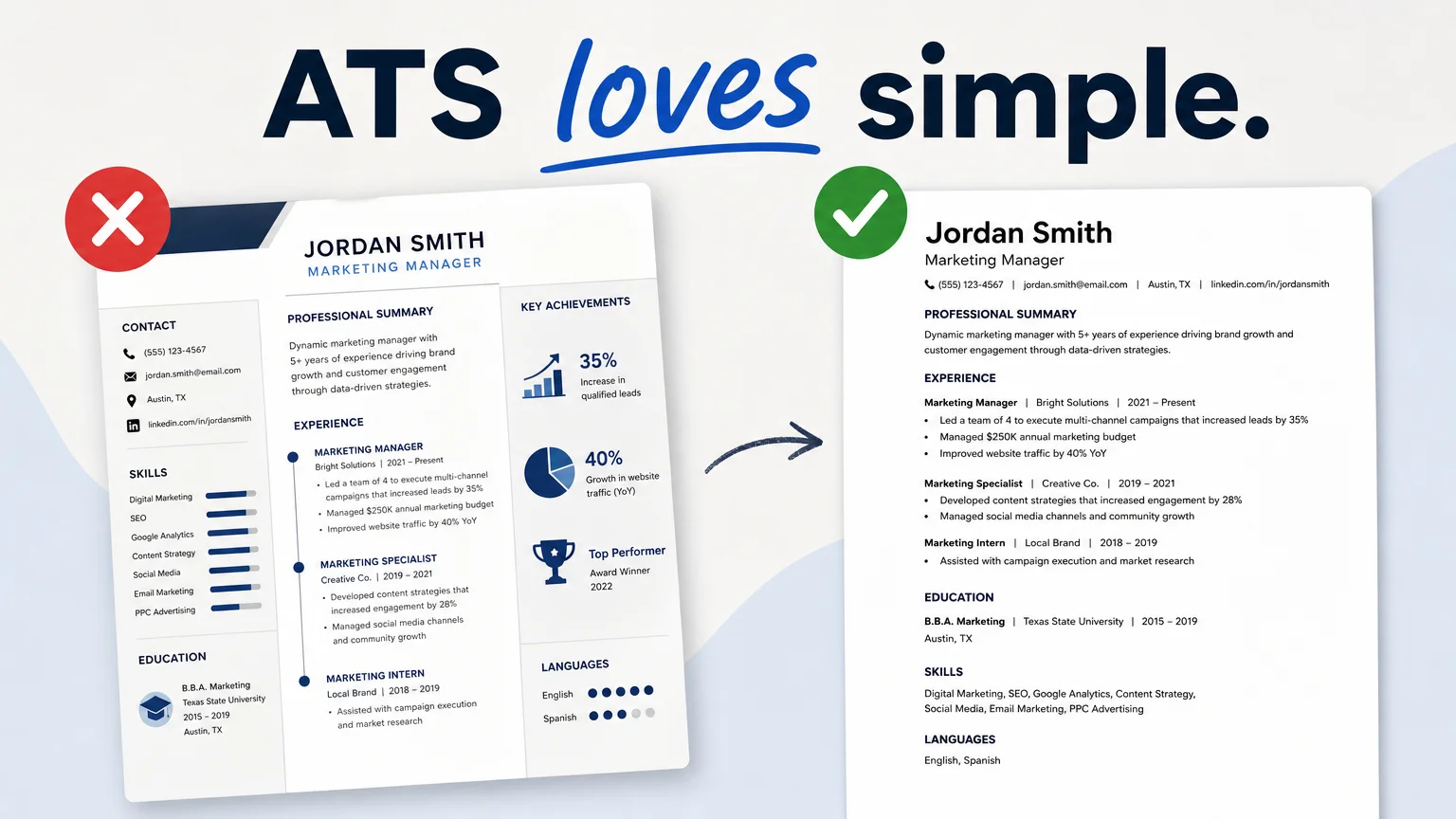
3. Make Your Resume ATS-Proof (Without Killing Design)
ATS (Applicant Tracking Systems) turn your resume into data. Fancy columns, graphics, and hidden tables can throw off the parser.
What ATS-friendly means in 2026:
- Simple section headers: Use plain labels like “Experience”, “Education”, and “Skills”, not clever titles such as “Where I’ve Been”
- Standard font: Stick with Arial, Calibri, or Roboto; skip script or decorative fonts
- No tables or text boxes: Bullet points and plain text work best
- Keywords from the job description: Match their exact phrases (e.g., use “project management”, not “managed projects”)
The one exception: In design or creative roles, you can send a fancier version to humans, but always keep a plain-text version ready for ATS.
For more on beating applicant tracking software, check out our guide to tailoring your resume for each job.
4. Lead Every Section With Your Biggest Win
Recruiters spend much of their time on the top third of your resume. Put your strongest achievement first in each section.
Example for a Sales role:
Regional Sales Manager | Acme Corp
Jan 2022, Present
- #1 in revenue among 12 regional managers in FY2025 ($4.2M total)
- Built a pipeline of 50+ enterprise accounts
- Trained 3 new hires who each hit quota in 60 days
The first bullet leads with the largest number on purpose.
Rule: Sort bullet points by impact, not chronology.
5. Kill the Filler Words (One Sentence at a Time)
Corporate language can make a resume vague. Words like “leverage,” “synergize,” “optimize,” “proactive,” and “innovative” need evidence behind them.
Before editing: “Leveraged cross-functional synergies to optimize team performance.” After editing: “Coordinated between sales and product teams to close 3 enterprise deals.”
The second version says what happened.
Go through your resume and remove:
- “Responsible for”
- “Utilized”
- “Team player” (show it, don’t say it)
- “Results-driven” (prove it with numbers)
- “Dynamic”
Test: Read each bullet point out loud. If it sounds like something a robot would say, rewrite it.
6. Tailor Every Resume (Even if It Takes 10 Minutes)
Generic resumes get ignored, and hiring managers can often spot a lack of tailoring.
The 10-minute customization process:
-
Copy the job description into a text file
-
Highlight keywords: specific tools, certifications, soft skills, industry terms
-
Match your skills section: if they list “Agile”, label it “Agile”, not “Scrum”.
-
Adjust your summary to name the role and the company.
-
Reorder bullet points so the most relevant achievement for that job leads.
Skip the 50 applications. Five solid, tailored ones will do far more.
Pro tip: Sending out 50 identical resumes a day? That’s time wasted. Fewer apps, each one customized, is the better play.
Combine this with our 3-line resume summary formula to improve your odds.
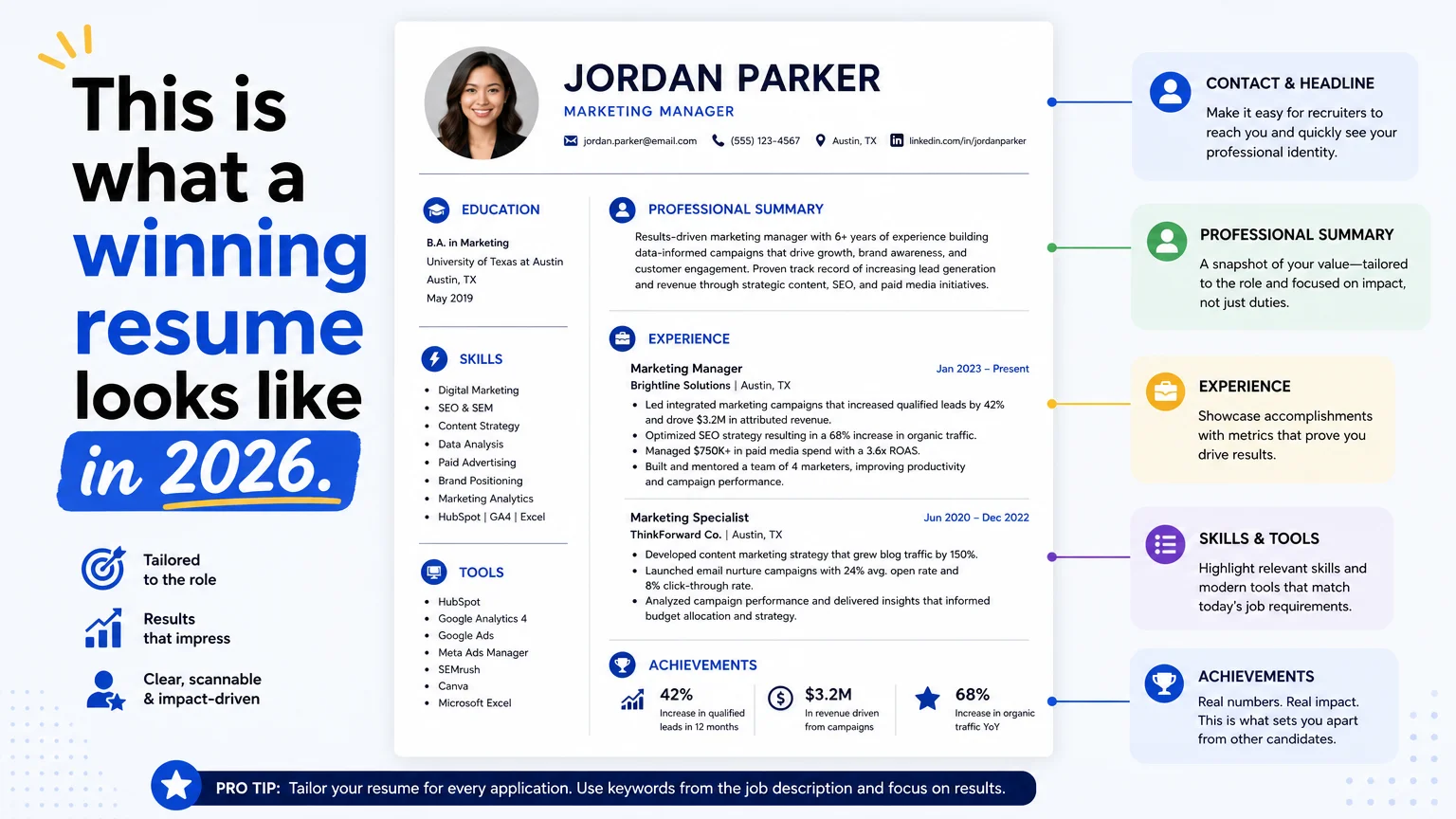
7. The Only Resume Format That Works in 2026
A practical resume format should be easy for people and parsing software to follow:
Header: Name + Phone + Email + LinkedIn (skip address and photo).
Professional Summary: Keep it to 2-3 lines covering role, experience, and a top result.
Skills: List hard skills, tools, languages, certifications, as bullets, capped at 8-12 items.
Experience:
- Reverse chronological order
- 4-6 bullet points per job
- Each bullet states an achievement, not a duty
Education: Institution, degree, year. Skip the GPA unless it’s exceptional or you just graduated.
Optional sections: Certifications, Languages, Volunteer work, only when relevant.
No hobbies. No “References available upon request”. And drop high school if you hold a college degree.
Key Takeaways
- Quantify everything. Numbers make claims believable.
- Tailor each resume. Generic applications get ignored.
- Lead with achievements. Duties are boring; results are compelling.
- Write for both ATS and humans. Simple formatting beats fancy design.
- Remove filler words. Every word should earn its place.
Writing a useful resume takes work, but it can make the difference between silence and callbacks.
Start building your ATS-friendly resume on Resumae.xyz. It’s free. Continue with the AI resume tailoring guide or compare AI resume builders vs resume tailoring tools.

About the author
Yuvraj Bajwa
Founder, Resumae
Yuvraj Bajwa is the founder of Resumae, an AI job-search workspace built as part of Coffee Drop Studio. He writes and reviews the resume, cover letter, interview, and application-tracking guidance on this site, drawing on the day-to-day work of building the tailoring, fit analysis, and ATS tools the articles describe.
- Founder
- Product lead
Related reading
The Complete 2026 Guide to Remote Resumes
Tailor your resume for remote roles in 2026 with remote keywords, ATS tips, AI tools, and a final checklist to land work-from-anywhere interviews.
How to Use AI for Salary Negotiation in 2026
Use ChatGPT, Perplexity, and other AI tools to research salary data, draft winning scripts, and role-play negotiation for free in 2026 with confidence.
LinkedIn Optimization Guide 2026: Get Recruited Faster
Turn your LinkedIn into a 24/7 job magnet in 2026. Follow data-backed steps for headlines, summaries, AI optimization, and a printable checklist.
Next step
Ready to build a resume that gets noticed?
Paste a job description and let AI tailor your resume - free plan, no credit card required.