How to Tailor a Cover Letter for a Specific Role
Stop sending generic cover letters in 2026. Learn practical steps to tailor your letter for a specific role, avoid mistakes, and stand out to hiring managers.
By Yuvraj Bajwa, Founder, WorkHunt
August 10, 2026 · Updated October 16, 2026 · 11 min read
2026 Hiring GuideWorkHunt articles are written to help job seekers make better application decisions and are reviewed against our editorial policy.

You spot a job posting that feels meant for you. The skills line up, the company’s mission clicks, and you can practically imagine yourself in the role. Then you sit down to draft a cover letter, and your mind goes blank.
That old template from the last handful of applications gets pulled out. A few company names get swapped in. You hit submit. Does that sound familiar?
Here’s the hard truth: that generic approach is why you’re not hearing back.
In seconds, hiring managers can spot a copied-and-pasted letter. It signals you didn’t care enough to understand what they needed. In a competitive market, that kills your chances fast.
The solution is learning to write a targeted cover letter, not a template, but a document built for one specific employer. One that speaks directly to what that employer needs.
Let me show you exactly how.
Why a One-Size-Fits-All Cover Letter Fails
Consider what a cover letter is meant to accomplish. It’s your opportunity to explain why you are the right match for this specific job, not why you’re a generally capable professional who might do okay.
A generic letter fails because it ignores the employer’s core question: “Why should we hire you for our position?”
According to Oxford University’s careers service, tailoring shows the employer you’ve really understood their organization and the role, rather than having fired off the same letter to every company (Oxford University Careers Service).
With a one-size-fits-all letter, you signal:
- You didn’t read the job description carefully
- You lack genuine interest in their company
- You’re after any job, not this one
None of those help your case.
The good news: tailoring a cover letter doesn’t take as long as you think. With a solid framework, customizing it for each role takes 20–30 minutes, a small investment for dramatically better results.
How to Write a Cover Letter for a Specific Role: The Process
Tailoring a cover letter for a specific role doesn’t require writing from scratch each time. Instead, follow a repeatable four-step process: deconstruct the job description, research the company, match your achievements to the role’s needs, and adjust your tone to fit the industry. Each step builds on the last, transforming a generic template into a persuasive argument for why you should be hired.
Step 1: Deconstruct the Job Description
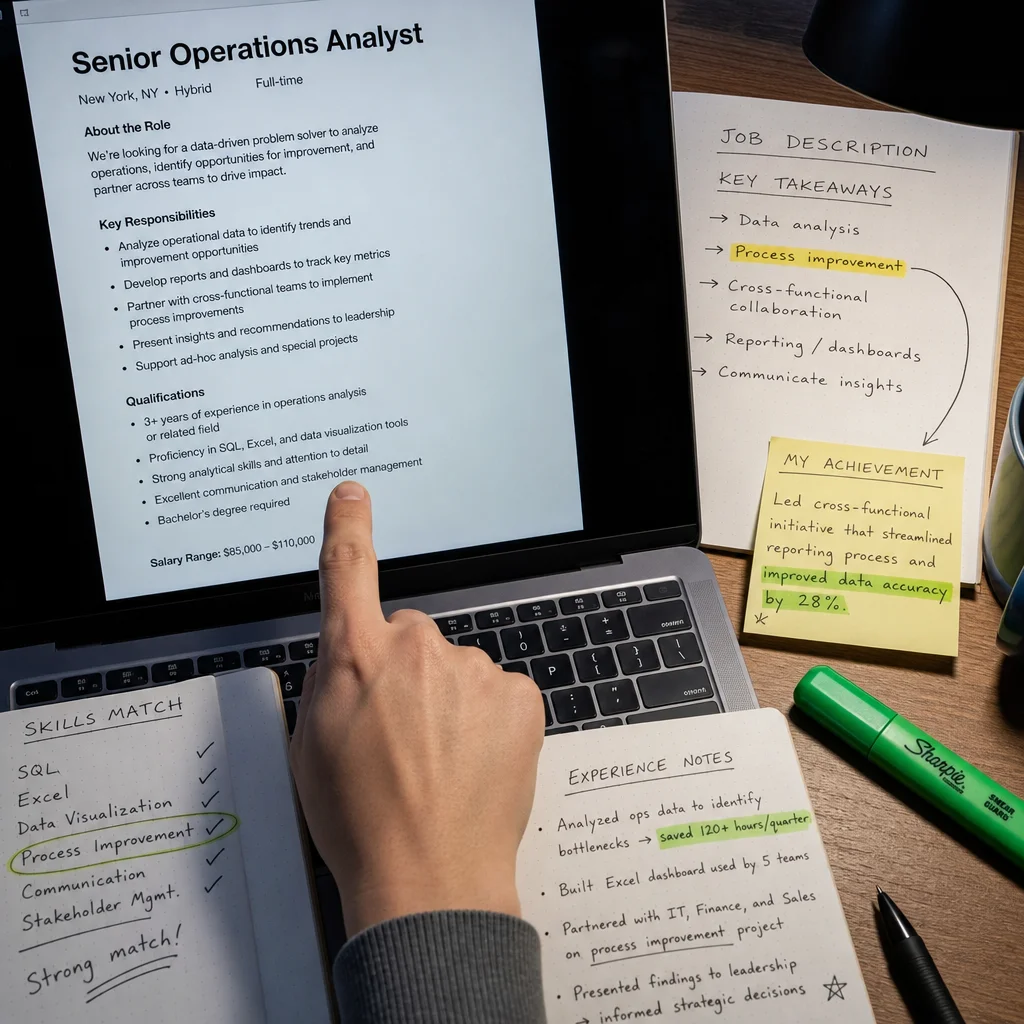
A deep understanding of the role comes before writing a single word. Skimming the job posting isn’t enough.
Focus on key elements:
- Required skills - hard skills like software, certifications, and technical abilities
- Preferred qualifications - these are just “nice-to-haves,” though they reveal priorities
- Core responsibilities - what your daily work would be
- Keywords and phrases - repeated terms are the employer’s top concerns
According to Indeed’s career experts, a strong cover letter shows how your experience fits the specific role and expands on skills more personally than a resume can (Indeed).
Here’s a tip: Make a short list of the top 5–7 requirements from the posting. For each one, note a concrete achievement or experience that proves you’ve done it before, including what the outcome was if possible.
That list becomes the spine of your letter. You don’t need to cover every single requirement. Focus on the most important ones where your evidence is strongest.
Step 2: Research the Company and Role
After deconstructing the job description, dig deeper. Generic research won’t help. You need insights that let you personalize your opening and demonstrate real interest.
Check these sources:
- The company website - start with their “About” page, blog, and news section. What are they currently focused on?
- LinkedIn - look at the company page, recent posts, and profiles of people in similar roles (University of Michigan Career Center).
- Job postings for similar roles - these can hint at what the company values across positions.
- Industry news: What’s the company dealing with right now, obstacles or opportunities?
- The hiring manager: If you can dig up their name, use it. It’s one of the most personal touches you can add. (Hunter Recruiting)
You don’t need to become a company expert. The goal is 2–3 specific details that prove you’ve done your research.
Put this into practice:
Instead of writing “I’m excited to apply for the Marketing Manager position at your company.”
Say “When I came across your recent campaign for the Community Connect initiative, I was impressed by how your team translated complex data into compelling storytelling. I’ve spent the last three years doing exactly that for B2B tech audiences.”
Spot the difference? That second one shows you actually looked into them and ties your experience directly to their work.
Step 3: Line Up Your Achievements With What the Job Needs
Here’s where the real work happens, turning what you’ve done into exactly what the employer is after.
Most people just rehash their job duties instead of achievements. But a peer-reviewed cover letter guide from PMC points out your letter should zero in on the specific role and show how your CV connects to what they’re hiring for (PMC).
Lead with something strong.
Your first paragraph needs two things:
- Name the role you’re after
- Give one solid reason you’re the person for it
Example: “With five years of experience scaling customer success programs for SaaS companies and an obsession with reducing churn, I’m excited to apply for the Customer Success Lead role at Acme Corp.”
That opening tells the hiring manager who you are and what you offer. No fluff.
Next, match your wins to the job description.
Take each requirement you flagged in Step 1. For every one, find a matching achievement:
| Job Requirement | Your Achievement |
|---|---|
| “Proven track record of increasing sales” | “Grew territory revenue from $1.2M to $2.8M in under 18 months” |
| “Experience with HubSpot” | “Led migration of 400+ contacts and automated 15 workflows, saving 10 hrs/week” |
| “Team leadership” | “Managed a team of 8 across 3 departments, reducing turnover by 25%” |
Here’s the formula: what you did + how you did it + a concrete result.
Even if the posting doesn’t ask for numbers, toss them in. Specific metrics make vague claims believable.
Keep your tone conversational, not corporate. LinkedIn’s career experts recommend writing naturally rather than sounding robotic (LinkedIn). After all, you’re talking to a person, not a machine.
Step 4: Adapt Your Tone and Emphasis by Industry
Cover letters shouldn’t all read the same way. The industry you’re targeting should drive both tone and focus.
Corporate / Traditional (Finance, Law, Consulting):
- Put results, delegation, and leadership at the center
- Use a more formal structure and language
- Lead with experience at similar companies or in related industries
- Example emphasis: “Delivered $3M cost savings through process reengineering across 5 business units”
Creative (Design, Marketing, Content):
- Let your personality and cultural fit show through
- Demonstrate your craft in the writing itself
- Link your portfolio or key projects
- Example emphasis: “My campaign for a fitness startup increased app downloads by 150% in Q3 - and got featured on Product Hunt”
Technical / Engineering:
- Focus on technical skills and project outcomes
- Name specific technologies and methodologies
- Keep things structured and logical
- Example emphasis: “Built a microservices architecture that reduced API response times by 60%, serving 2M daily users”
Nonprofit / Social Impact:
- Emphasize shared values and mission
- Show commitment beyond just salary
- Highlight community impact
- Example emphasis: “I’ve organized 15 community food drives serving 2,000+ families - experience that informs my passion for our shared mission”
LinkedIn’s guidance on customizing cover letters stresses that tailoring means you address each company and position’s unique requirements, culture, and goals (LinkedIn). That’s not just about swapping a few words around. It’s shifting your emphasis based on what an employer values most.
Pro tip: Read the language in the job description. A direct, no-nonsense tone means your letter should be direct and professional, too. Warm and mission-driven language lets your personality show through more.
Common Mistakes That Kill Role-Specific Cover Letters
Even with the best intentions, some pitfalls can undermine a tailored approach. Stay away from these:
1. The generic opening line
“I’m writing to express my interest in the [role] position at [company].”
Every hiring manager has read that opening line more times than they can count. Try something different: name a shared contact, reference a project they worked on, or explain in one sentence why this role pulls at you.
2. Keyword stuffing
The posting asks for “CRM experience” and “data analysis,” so you mirror those phrases back verbatim. It doesn’t help. The result reads robotic, and advisors note that listing keywords without showing how you’d use them fails to make your case (Focus People).
Weave those concepts into your achievement stories instead. “I used Salesforce data to identify a 20% churn risk segment and built a targeted retention campaign.”
3. Ignoring the job description
The most common mistake is grabbing a template and never checking it against the actual posting. Your letter should reference the specific skills and qualifications listed there, not generic attributes, as Furman University’s career blog stresses (Furman University).
4. Making it too long
Keep it to one page maximum. The point is to make the hiring manager want to open your resume, not to replace it. Anything that doesn’t directly support your fit for this role gets cut.
5. Forgetting to mention something unique
A niche certification, a standout project, a career pivot with a good story behind it - these set you apart. If you don’t highlight what makes you different, you blend in.
Your Role-Specific Cover Letter Checklist
Run through this before you hit submit:
Research & Preparation:
- Analyzed the job description for top 5–7 requirements
- Researched company website, LinkedIn, and recent news
- Found the hiring manager’s name (if possible)
- Identified 2–3 specific company details to reference
Content & Structure:
- Opening states the role and gives a compelling hook
- Middle matches top requirements with quantified achievements
- Second half ties your experience to what the company actually needs
- Closing restates your enthusiasm and asks for action
Style & Tone:
- Sounds like a real person, not a corporate bot
- Uses keywords naturally; nothing feels stuffed in
- Keeps things tight, under one page
- Digs into the specific role, not just the industry
Final Polish:
- Catches typos and grammar mistakes
- Verifies the company name and hiring manager
- Saves as PDF (unless told otherwise)
- Submits within a reasonable time, within 1–2 weeks of the posting going up
When Tailoring Matters Most (And When It’s Less Critical)
A tailored cover letter is always the right call. That said, some situations demand more of your time than others.
Go all-in (20–30 minutes):
- The dream role or the company you really want
- Mid-to-senior jobs where fit is everything
- Positions where you’re a little underqualified and need to make a case
- Companies with strong culture brands that value authenticity
Put in a moderate shift (10–15 minutes):
- Roles you’re clearly qualified for, with a straightforward posting
- Jobs where you already have a referral or internal recommendation
- High-volume applications where your response rate is already decent
Short route (5 minutes):
- Sometimes a tight, focused letter beats a long, rambling one. Indeed points out that some employers prefer a short paragraph plus bullet points over a lengthy narrative (Indeed).
The rule is simple: match your effort to the role’s importance. If the job genuinely excites you, put in the time to make your letter stand out.
Using an AI Cover Letter Generator Without Sounding Generic
AI can draft a tailored letter in seconds, but only if it works from real context: the job description, your resume, and the actual reasons you fit. A generator fed only a job title produces exactly the template letter this guide warns against.
A good AI draft should:
- Name the role and connect it to what the company needs
- Pull its evidence from your resume and never invent experience you don’t have
- Stay short enough for a recruiter to scan in seconds
- Read like a professional note, not a filled-in template
Write the letter after you have tailored the resume. By then, the strongest role-specific points are already chosen, and the letter can expand on them instead of repeating them. Three short paragraphs are enough:
- Why this role, and why now
- The strongest proof you can pull from your experience
- A concise close that points back to the attached resume
Then edit the draft so it sounds like you, and check every claim against your resume.
WorkHunt builds cover letters from the same job context it uses for resume tailoring, so the letter, the tailored resume, the fit analysis, and your application tracker all stay aligned. See how to tailor your resume for the resume side of the same workflow.
The Bottom Line
A cover letter is not a resume summary. Its purpose is to build a compelling case that you, specifically, are the solution to this employer’s specific problem.
Do your research first. Match your achievements directly to what they’ve asked for. Adjust your tone to fit their industry and their culture. Above all, show them, don’t just tell them, why you belong there.
Your homework: Pick a job posting you actually care about. Spend 30 minutes taking it apart and studying it. Then write a tailored letter using the framework above. You’ll feel the difference right away.

Yuvraj Bajwa
Editorial AuthorFounder, WorkHunt
Yuvraj Bajwa is the founder of WorkHunt, an AI job-search workspace built as part of Coffee Drop Studio. He writes and reviews the resume, cover letter, interview, and application-tracking guidance on this site, drawing on the day-to-day work of building the tailoring, fit analysis, and ATS tools the articles describe.
- Founder
- Product lead