Resume Summary Examples for Every Career Stage 2026
Stop writing one-size-fits-all summaries in 2026. Get stage-specific resume summary templates for entry to executive levels that actually get read.
By Yuvraj Bajwa, Founder, WorkHunt
July 12, 2026 · Updated August 7, 2026 · 6 min read
2026 Hiring GuideWorkHunt articles are written to help job seekers make better application decisions and are reviewed against our editorial policy.

Your resume summary is one of the first things a hiring manager reads after your name. Use that space to show what you do and where you can contribute.
They write a generic objective like “Seeking a challenging position where I can utilize my skills to contribute to organizational growth.” That tells the reader nothing. It’s corporate noise.
Your summary should reflect your career stage. A recent graduate needs different evidence from a senior leader, and a career changer needs to connect past experience to a new target.
The sections below include formulas and examples for each career stage.
Entry-Level Resume Summaries (0–3 Years Experience)
You don’t have years of experience to lean on. That’s fine. Your summary should highlight your education, internships, and transferable skills instead.
Formula: [Adjective] + [Degree/Major] + [Key Skill] + [Career Goal]
Examples:
“Recent Marketing graduate with internship experience in social media analytics and content creation, seeking to drive brand engagement at a growth-stage company.”
“Detail-oriented Computer Science graduate with a 3.8 GPA and project experience in Python, SQL, and agile development. Looking to launch a career as a software engineer at a data-driven organization.”
“Motivated Communications major with 2+ years of part-time customer service experience and strong writing skills. Eager to contribute to a public relations team.”
What to include:
- Your degree and any honors (Dean’s list, cum laude)
- Relevant internships or volunteer work
- Strong GPA (3.5 or above)
- Key technical or soft skills
- A clear career goal that matches the job you’re applying for
What to skip: Your high school achievements, unrelated part-time jobs, and generic descriptions like “hardworking and dedicated.” Be specific.
Sources: Indeed, ResumeWorder, MyPerfectResume
Mid-Career Resume Summaries (4–10 Years Experience)
You have results to lead with. Your summary should state your experience, strongest achievements with numbers, and what you bring to the new role.
Formula: [Job Title] + [Years] + [Top 2–3 Achievements/Metrics] + [Value Proposition]
Examples:
“Project Manager with 7+ years leading cross-functional teams to deliver $2M+ initiatives on time and under budget. Skilled in Agile methodology, stakeholder communication, and risk mitigation.”
“Sales Manager with 6 years of experience consistently exceeding quota by 20%+ annually. Built and mentored a team of 12 reps, driving $4M in new revenue. Proven track record in B2B SaaS sales.”
“Registered Nurse with 8 years in critical care, managing up to 6 patients per shift. Expertise in emergency response, patient education, and interdisciplinary collaboration. BLS and ACLS certified.”
What to include:
- Your current or most recent job title
- Years of experience (rounded up if close)
- Quantified achievements (dollars, percentages, time saved)
- Skills relevant to the target role
- A value proposition: what makes you different?
What to skip: Listing every job duty from your resume. Your summary should highlight your best hits, not your full job description.
Sources: MyPerfectResume, LiveCareer, Arielle
Senior & Executive Resume Summaries (10+ Years / C-Suite)
At this level, focus on leadership. Your summary should show your strategic impact, the scale of your work, and the business outcomes you delivered.
Formula: [Senior Title] + [Industry/Expertise] + [Leadership Impact] + [Strategic Outcome]
Examples:
“Chief Technology Officer with 15+ years driving digital transformation and scaling engineering teams from 20 to 200+. Spearheaded SaaS platform growth from $5M to $50M ARR over four years.”
“VP of Sales with a decade of experience building and leading high-performance teams across North America and Europe. Grew annual revenue from $10M to $40M in three years. Expertise in enterprise sales, channel partnerships, and go-to-market strategy.”
“Operations Director with 12+ years in manufacturing, overseeing 5 facilities with 500+ employees. Reduced operational costs by 22% through lean process improvements while maintaining 99% on-time delivery.”
What to include:
- Your C-suite or senior title
- Industry or domain expertise
- Team size you’ve managed
- Revenue, P&L, or budget responsibility
- Strategic outcomes, not tactical tasks
What to skip: Day-to-day responsibilities, soft skills without proof, and anything that sounds like a mid-career summary. You’re selling vision, not effort.
Sources: Page Executive, ResumeWorded, ResuFit
Career-Change Resume Summaries
When you switch fields, recruiters need to understand the target role and why your past experience applies. Lead with the new role, then connect it to your transferable skills.
Formula: [Target Role] + [Years in Previous Field] + [Transferable Skill 1, Skill 2] + [Motivation/Value]
Examples:
“Results-driven operations manager transitioning to product management, leveraging 6+ years of process optimization, data analysis, and cross-functional team leadership. Passionate about building user-centric digital products.”
“Experienced teacher with 8 years of classroom management and curriculum design, transitioning to corporate training and development. Skilled in instructional design, public speaking, and learner engagement.”
“Marketing professional with 5 years of content strategy and SEO experience, moving into UX writing. Expertise in user research, information architecture, and conversion-focused copywriting.”
What to include:
- The target role (make it crystal clear)
- Your years of experience in the previous field
- 2–3 transferable skills relevant to the new role
- A brief statement of motivation or passion
What to skip: Irrelevant job history, old job titles without context, and anything that makes the reader guess what you’re looking for.
Sources: LinkedIn, Wharton, ResumeWorded
Common Mistakes to Avoid by Stage
Entry-level: Don’t say “seeking a challenging position.” Be specific about what you want to do. Don’t pad with high school achievements or irrelevant jobs.
Mid-career: Don’t bury your metrics. If you improved something by 30%, say it in the first sentence. Keep the summary to 2-3 lines.
Senior/executive: Don’t list tactical tasks. Nobody cares that you “managed daily operations.” They care about the $10M in revenue you drove. Don’t use corporate buzzwords like “synergy” or “optimize.”
Career change: Don’t lead with your old job title. The first word should be the role you’re targeting. Include only experience that transfers to the new role.
Quick-Reference Template Cheat Sheet
| Career Stage | Template | Example |
|---|---|---|
| Entry-Level | [Adjective] + [Degree/Major] + [Key Skill] + [Career Goal] | Recent Marketing grad with internship experience in social media analytics… |
| Mid-Career | [Job Title] + [Years] + [Top 2–3 Metrics] + [Value Proposition] | Project Manager with 7+ years delivering $2M+ initiatives on time… |
| Senior/Exec | [Senior Title] + [Industry] + [Leadership Impact] + [Strategic Outcome] | CTO with 15+ years scaling teams and growing ARR from $5M to $50M… |
| Career Change | [Target Role] + [Years in Previous Field] + [Transferable Skills] + [Motivation] | Operations manager moving into product management, with 6+ years of process optimization behind them… |
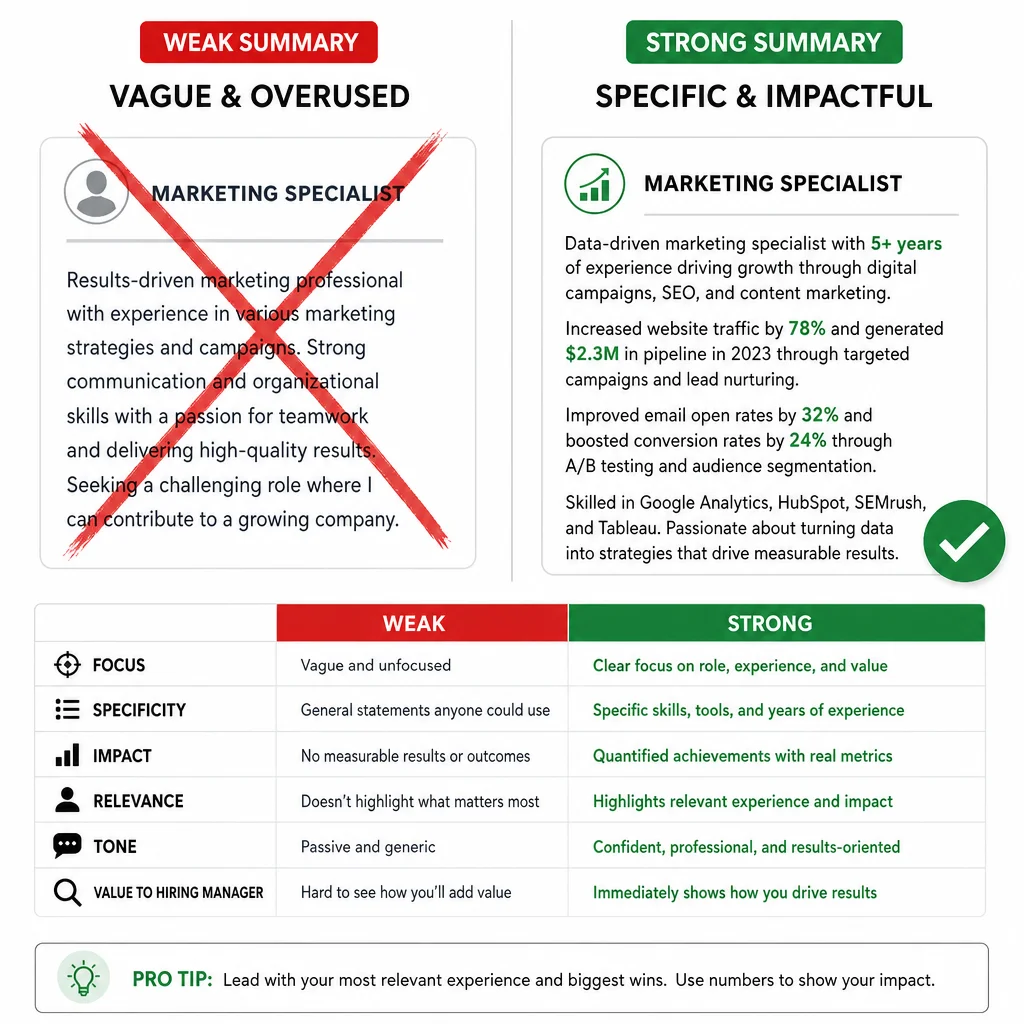
Tailor Every Summary to the Job Description
One summary for every application? Don’t.
Instead, pull the keywords from the job description and work them into your summary naturally. If the role asks for “agile project management” and “stakeholder communication”, those exact phrases need to show up in what you write.
That tweak takes about 5 extra minutes.
Match your career stage first, then shape the rest of the resume around that summary.

Yuvraj Bajwa
Editorial AuthorFounder, WorkHunt
Yuvraj Bajwa is the founder of WorkHunt, an AI job-search workspace built as part of Coffee Drop Studio. He writes and reviews the resume, cover letter, interview, and application-tracking guidance on this site, drawing on the day-to-day work of building the tailoring, fit analysis, and ATS tools the articles describe.
- Founder
- Product lead